Japanese | English
– A Giant Whose Discovery Meant Its Death –
Steller’s Sea Cow
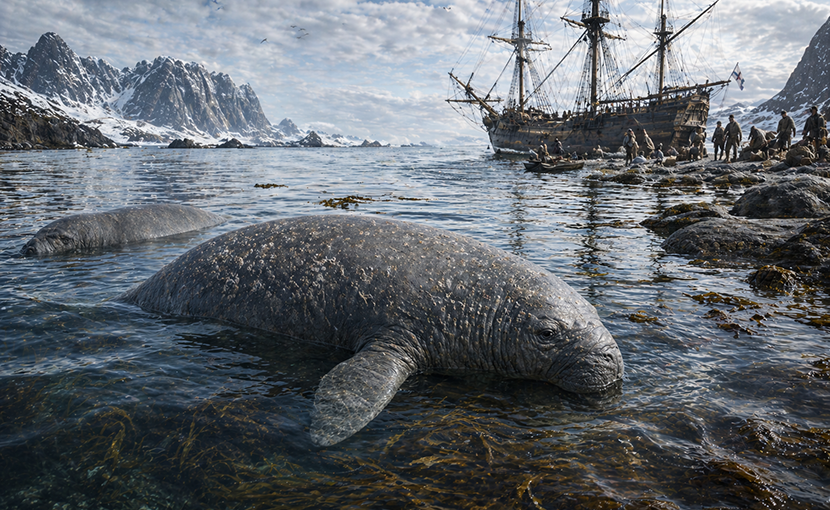
In the 18th century,
in the cold waters of the Bering Sea,
a massive marine mammal lived in quiet isolation.
This was Steller’s sea cow.
It had evolved in a world without human hunters,
without persistent predation,
and without the need to flee.
But the moment it was discovered by humans,
its fate was sealed.
Basic Information
| Classification | Mammalia / Sirenia / Dugongidae |
|---|---|
| Scientific name | Hydrodamalis gigas |
| Time period | Holocene–1768 |
| Geographic range | Bering Sea (Commander Islands region) |
| Length | ~7–9 meters |
| Body mass | Up to ~10 metric tons |
| Diet | Marine algae (strict herbivore) |
| Distinctive traits | Enormous size, thick skin, extremely slow movement |
A Sea Without Predators
In the waters where Steller’s sea cow lived:
- large predators were scarce,
- human presence was absent,
- food sources (kelp) were abundant.
There was no need to escape.
No evolutionary pressure to develop fear.
The species was perfectly adapted to a safe environment.
Scientific Discovery and Immediate Exploitation
In 1741,
the naturalist Georg Wilhelm Steller
documented the species.
But this “discovery” did not lead to protection.
Instead, it triggered:
- intensive hunting by sailors,
- use of meat, fat, and hide,
- exploitation as a reliable food source for expeditions.
Scientific recognition and extinction began simultaneously.
A Shockingly Rapid Extinction
Discovery: 1741
Extinction: 1768
Just 27 years.
For a large mammal,
this represents one of the fastest extinctions in recorded history.
Why It Could Not Recover
Steller’s sea cow possessed traits that made recovery impossible:
- extremely slow reproduction,
- limited range,
- no fear of humans,
- no effective escape behavior.
Combined with
the strategic use of the islands as supply stations,
there was no opportunity for population recovery.
A Life Trapped by Geography
Steller’s sea cow had nowhere to go.
- confined to island waters,
- surrounded by harsh ocean conditions,
- suddenly exposed to global human expansion.
For this species,
the sea itself became a cage.
Why This Extinction Matters
This extinction was not driven by:
- agriculture,
- empire-building,
- long-term environmental transformation.
Instead, it reveals something more immediate:
human arrival alone can be sufficient to cause extinction.
Steller’s sea cow did not resist.
It did not flee.
It did not fight.
And yet,
the moment it became known to the world,
its future disappeared.
The Age of Exploration gave humanity new maps.
At the same time,
it erased entire species from those maps.