Japanese | English
– A Bird That Lost All Escape the Moment the World Arrived –
The Dodo
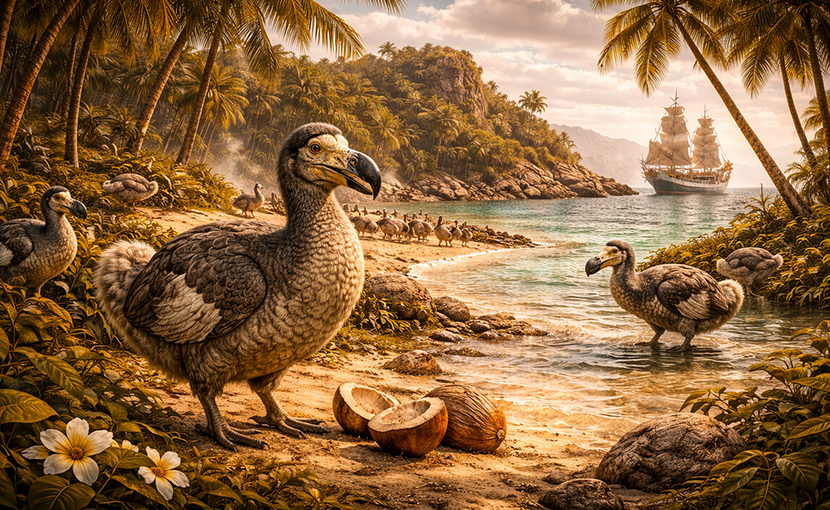
Once, on a remote island in the Indian Ocean,
there lived a large, flightless bird.
Its name was the dodo.
It had evolved in a world without humans,
without land predators,
without the need to flee or fear.
And then, one day,
the world arrived.
Basic Information
| Classification | Aves / Columbiformes / Columbidae |
|---|---|
| Scientific name | Raphus cucullatus |
| Time period | Holocene–late 17th century |
| Geographic range | Mauritius (endemic) |
| Heigh | ~1 meter |
| Weigh | ~10–20 kg |
| Diet | Fruits and seeds |
| Distinctive traits | Loss of flight, absence of fear toward humans |
An Island as a Safe World
On Mauritius, the dodo lived in an environment where:
- terrestrial predators were absent,
- human influence was unknown,
- competition was minimal.
In such conditions:
- flight was unnecessary,
- vigilance had no evolutionary value,
- fear conferred no advantage.
The dodo was not poorly adapted.
It was perfectly adapted to an island world.
The Rupture of the Age of Exploration
At the end of the 16th century,
European ships reached the Indian Ocean.
In that moment,
the dodo’s isolated world became suddenly connected to the globe.
With the ships came:
- sailors who hunted indiscriminately,
- pigs, rats, and monkeys carried aboard,
- deforestation and the establishment of supply bases.
For the dodo,
every one of these was an unfamiliar threat.
The Bird That Did Not Run
The dodo did not fear humans.
This was not foolishness.
It was the outcome of evolution
in a world where fear was unnecessary.
But to sailors of the Age of Exploration,
this meant something else:
an animal that could be captured without resistance.
The True Cause: Introduced Species
Humans alone did not exterminate the dodo.
More devastating were the animals humans brought with them:
- pigs destroyed nests,
- rats consumed eggs,
- monkeys preyed on chicks.
The island ecosystem collapsed
under the pressure of introduced species.
The dodo had no defenses against this new reality.
A Shockingly Short Road to Extinction
- First recorded encounter: 1598
- Extinction: late 17th century (last reliable sighting around 1662)
Within mere decades of discovery, the species was gone.
This ranks among the fastest recorded extinctions in human history.
Why the Dodo Became a Symbol
The dodo’s extinction was not driven by:
- agriculture,
- empire-building,
- or long-established hunting cultures.
Instead, it revealed something new:
global connection itself had become a force capable of causing extinction.
Lives Trapped on Islands
The dodo did not fail to escape.
It was confined within a world where escape had never been necessary.
An island that had once been a sanctuary
became a cage the moment the world expanded.
The dodo did not vanish because it was weak.
It vanished because
it had never needed to know the outside world.
The Age of Exploration gave humanity new maps.
At the same time,
it erased the futures of countless island species.