Japanese | English
– A Giant Bird Whose End Began the Moment Humans Arrived –
The Moa (New Zealand)
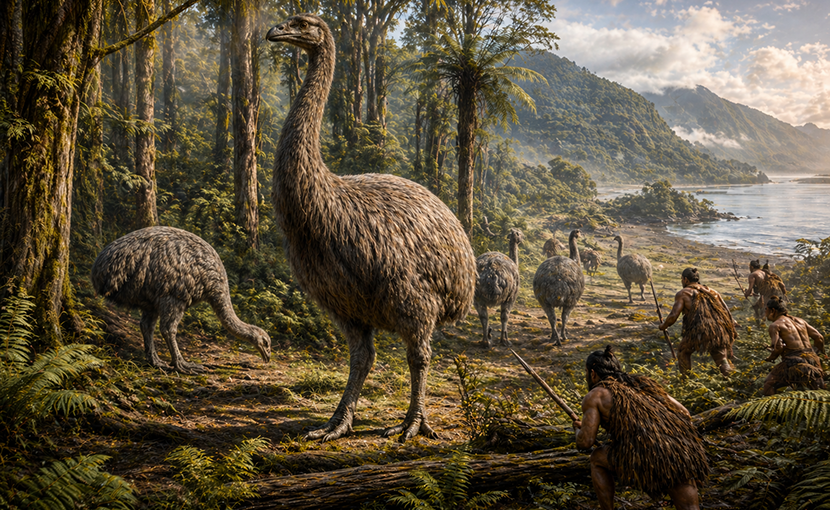
Once, in New Zealand,
there lived giant flightless birds.
They were known as the moa.
Some species stood over three meters tall,
walking through forests and open landscapes
as the largest land animals of the islands.
But they had never encountered humans.
And then, one day,
humans arrived.
Basic Information
| Classification | Aves / Ratites (broad grouping) / Dinornithiformes |
|---|---|
| Representative genera | Dinornis and related species |
| Time period | Holocene–around the 15th century |
| Geographic range | New Zealand (endemic) |
| Height | Up to ~3.6 meters (fully extended) |
| Body mass | Over 200 kg |
| Diet | Herbivorous |
| Distinctive traits | Complete loss of flight, evolution in predator-free environments |
Evolution Without Predators
In prehistoric New Zealand:
- there were no terrestrial mammalian predators,
- competition was minimal,
- birds dominated the ecosystem.
Within this environment, moa:
- evolved large body size,
- lost the need for flight,
- did not develop strong escape behaviors.
They were perfectly adapted to a closed island system.
Human Arrival — A Decisive Turning Point
Around the 13th century,
Polynesian settlers (ancestors of the Māori)
arrived in New Zealand.
In that moment,
the moa’s world collapsed.
- intensive hunting began,
- forests were burned and cleared,
- habitats changed rapidly.
Moa became
a primary food resource.
An Ideal Prey
Moa possessed traits that made them easy targets:
- little fear of humans,
- limited escape response,
- large, conspicuous bodies.
To human hunters,
they were exceptionally accessible prey.
The Speed of Extinction
Following human arrival:
moa disappeared within approximately 100–200 years.
For such large animals,
this represents an unusually rapid extinction.
Cascading Ecological Collapse
The extinction of the moa did not occur in isolation.
- The Haast’s eagle, which preyed on moa, also went extinct
- Vegetation patterns shifted
- Ecological balances were disrupted
This is a classic example of
whole-ecosystem collapse on islands.
Why the Moa Matters
The extinction of the moa did not require:
- advanced technology,
- large-scale civilization,
- long-term environmental transformation.
It required only one condition:
the arrival of humans.
Lives Trapped on Islands
The moa could not escape.
confined within islands,
unprepared for predation,
unable to adapt to sudden change.
The island was both sanctuary
and inescapable enclosure.
The moa did not vanish because it was weak.
It vanished because
it was too perfectly adapted to its world.
The Age of Exploration expanded human horizons.
At the same time,
it marked the beginning of the end
for many isolated forms of life.