Japanese | English
– When Gigantism Became a Liability –
The Elephant Bird (Aepyornis)
Once, on the island of Madagascar,
there lived the largest bird in the world.
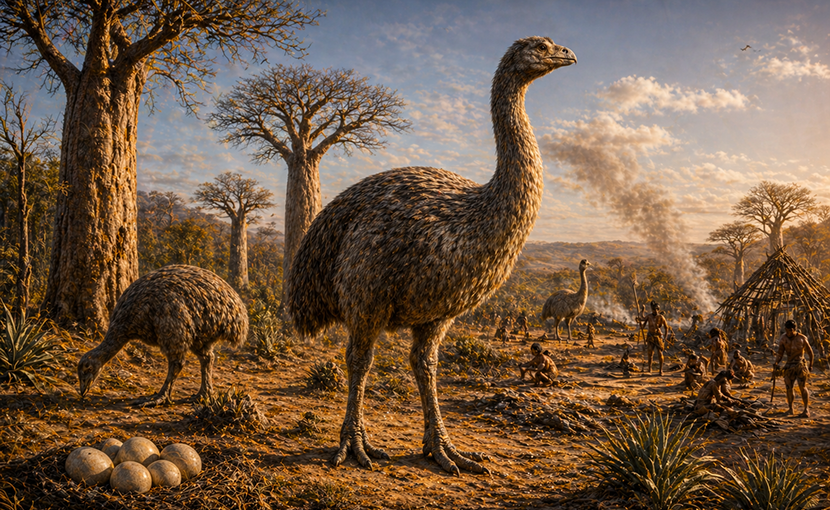
It was known as the elephant bird.
Standing nearly three meters tall
and laying the largest eggs ever recorded,
it represented an extreme form of evolution shaped by isolation.
Yet even this giant
quietly disappeared
after encountering humans.
Basic Information
| Classification | Aves / Ratites (broad grouping) / Aepyornithiformes |
|---|---|
| Scientific name | Aepyornis spp. |
| Time period | Holocene–around the 17th century |
| Geographic range | Madagascar (endemic) |
| Height | Up to ~3 meters |
| Body mass | Over 400 kg |
| Diet | Herbivorous / frugivorous |
| Distinctive traits | Flightlessness, extreme gigantism, enormous eggs |
The Peak of Predator-Free Evolution
Madagascar remained isolated for millions of years.
As a result:
- large mammalian predators were absent,
- birds evolved into dominant ecological roles,
- ecosystems developed in unique directions.
The elephant bird represented the extreme of this process.
It did not fly.
It did not flee.
It became enormous.
On an island, this was a successful strategy.
Human Arrival — A Gradual Collapse
Human settlement in Madagascar
was not as rapid or concentrated as in New Zealand.
Arrival around the first millennium CE
Introduction of agriculture and livestock
Expansion of deforestation
The elephant bird did not vanish immediately.
But it declined steadily over time.
Eggs as a Critical Weakness
One of the elephant bird’s defining traits—its enormous eggs—
became its greatest vulnerability.
- easy to collect,
- highly nutritious,
- directly tied to reproductive success.
Egg harvesting alone
can collapse a population
without killing adult individuals.
It functioned as a quiet mechanism of extinction.
Why It Could Not Survive
The elephant bird possessed several traits
that were harmless in isolation, but fatal after human contact:
- slow growth and reproduction,
- low population density,
- lack of fear toward humans,
- strong dependence on stable habitats.
Once connected to the wider world,
these became irreversible disadvantages.
Island Gigantism and Its Consequences
On islands:
- small animals often grow larger,
- large animals often shrink.
The elephant bird exemplifies this “island rule.”
But gigantism carries a cost:
large bodies are highly visible,
and visibility invites exploitation.
Why This Extinction Matters
Unlike the rapid extinction of the dodo or moa,
the elephant bird disappeared more gradually.
Its extinction reflects:
- sustained human pressure,
- cumulative ecological disruption,
- long-term environmental change.
Yet the underlying cause remains the same:
the continued presence of humans reshapes ecosystems over time.
The elephant bird did not vanish suddenly.
It faded—slowly, but inevitably.
Its extinction demonstrates that
human impact is not always immediate,
but it is often persistent and irreversible.
A bird that left behind the largest eggs in history
was unable to leave behind a future.