

Japanese | English
The Six Essential Elements of Life
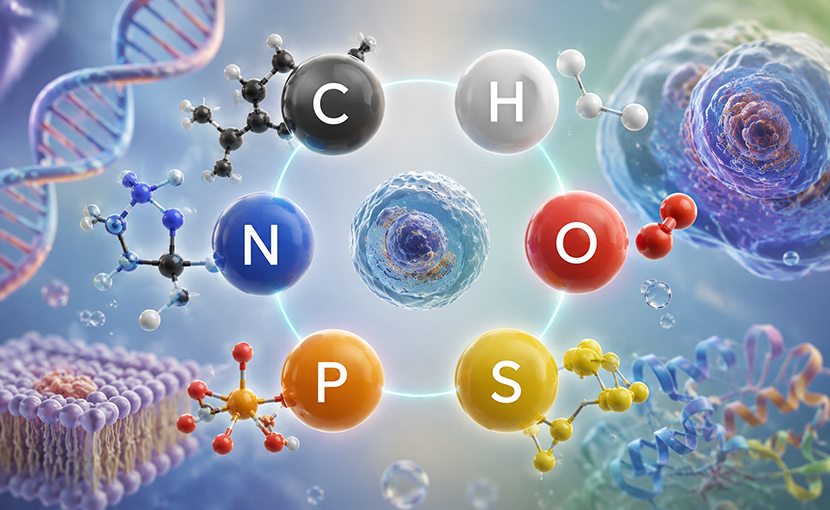
All living organisms on Earth—from humans and animals to plants and microorganisms—are primarily composed of just six chemical elements.
These six elements are collectively known as CHNOPS, an acronym formed from their chemical symbols:
- C – Carbon
- H – Hydrogen
- N – Nitrogen
- O – Oxygen
- P – Phosphorus
- S – Sulfur
Together, these six elements account for more than 98% of the mass of most living organisms and form the chemical foundation of life.
Why Are These Six Elements So Important?
Every living organism must be able to:
- Build and maintain its body
- Produce and use energy
- Store and transmit genetic information
- Carry out countless chemical reactions
CHNOPS elements possess the unique chemical properties needed to perform these functions.
Among them, carbon is especially important because it can form four stable chemical bonds, allowing it to create an enormous variety of complex molecules. For this reason, carbon is often called the backbone of life.
1. Carbon (C) The Backbone of Life
Carbon is the most important element in living organisms.
Because each carbon atom can form four covalent bonds, carbon atoms can link together into long chains, rings, and complex three-dimensional structures. This remarkable flexibility allows carbon to build the large molecules required for life.
Carbon forms the structural framework of:
- Proteins
- Carbohydrates
- Lipids (fats)
- DNA
- RNA
Without carbon, life as we know it could not exist.
Main Functions
- Forms the backbone of biological molecules
- Stores and supplies energy
- Builds cellular structures
2. Hydrogen (H) The Lightest and Most Abundant Element
Hydrogen is the most abundant element in the universe.
In living organisms, hydrogen is found primarily in:
- Water (H₂O)
- Organic compounds
- ATP (the cell’s energy currency)
Hydrogen ions (H⁺) also play a critical role in producing ATP during cellular respiration.
Main Functions
- Component of water
- Energy production
- Maintains acid-base balance (pH)
3. Nitrogen (N) Essential for Proteins and Genetic Material
Although Earth’s atmosphere is about 78% nitrogen, most organisms cannot use atmospheric nitrogen directly.
Plants absorb nitrogen from the soil in the form of nitrate or ammonium ions and use it to produce amino acids.
Nitrogen is an essential component of:
- Amino acids
- Proteins
- DNA
- RNA
Main Functions
- Builds amino acids
- Forms proteins
- Stores genetic information
4. Oxygen (O) The Element That Powers Cellular Respiration
Oxygen is far more than the gas we breathe.
It is also a major component of:
- Water
- Carbohydrates
- Proteins
- DNA
During cellular respiration, oxygen accepts electrons, allowing cells to produce large amounts of ATP efficiently.
Main Functions
- Cellular respiration
- Component of water
- Energy production
5. Phosphorus (P) The Key to Energy and DNA
Although phosphorus is present in relatively small amounts, it is indispensable for life.
Phosphorus is found in:
- DNA
- RNA
- ATP
- Phospholipids that make up cell membranes
ATP, which contains phosphorus, serves as the primary energy carrier in nearly every biological process.
Main Functions
- ATP production
- DNA and RNA structure
- Cell membrane formation
6. Sulfur (S) Stabilizing Protein Structure
Sulfur is mainly found in the amino acids:
- Cysteine
- Methionine
Sulfur atoms form disulfide bonds, which help proteins fold into their proper three-dimensional shapes.
These bonds are essential for the stability and function of many enzymes, hormones, and antibodies.
Main Functions
- Stabilizes protein structure
- Supports enzyme function
- Regulates biological reactions
Four Major Biomolecules Built from CHNOPS
The CHNOPS elements combine to form the four major classes of biological macromolecules.
| Biomolecule | Main Elements | Primary Function |
|---|---|---|
| Carbohydrates | C・H・O | Energy source |
| Lipids | C・H・O | Energy storage and cell membranes |
| Proteins | C・H・O・N・S | Body structure and enzymes |
| Nucleic Acids (DNA & RNA) | C・H・O・N・P | Genetic information |
CHNOPS Alone Is Not Enough
Although CHNOPS forms the chemical foundation of life, many other elements are also essential.
Examples include:
| Element | Biological Role |
|---|---|
| Calcium (Ca) | Bones, teeth, and cellular signaling |
| Sodium (Na) | Nerve impulse transmission |
| Potassium (K) | Cell function and fluid balance |
| Magnesium (Mg) | Chlorophyll and ATP-related reactions |
| Iron (Fe) | Hemoglobin and electron transport |
These are known as essential minerals or trace elements, and even in small amounts they are vital for life.
Summary
Despite the extraordinary diversity of life on Earth, every known organism shares the same chemical foundation: CHNOPS.
Carbon provides the structural framework of life. Hydrogen and oxygen form water and drive energy metabolism. Nitrogen builds proteins and genetic material. Phosphorus powers cellular energy transfer and supports DNA and RNA. Sulfur stabilizes protein structures and enables countless biochemical reactions.
Together, these six elements make possible the incredible complexity of life—from microscopic bacteria to giant whales and human beings. Understanding CHNOPS is one of the first steps toward understanding life itself.









コメント