Japanese | English
– The Guardian That Became a Pest –
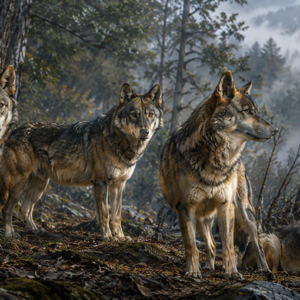
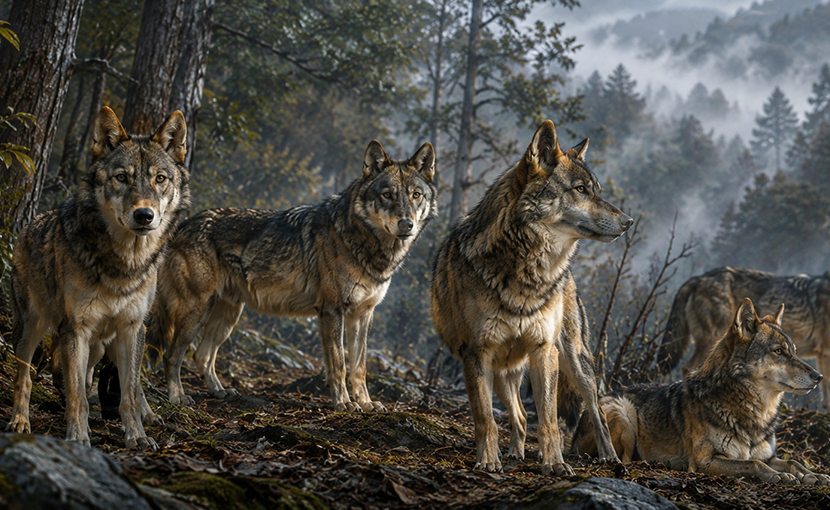
The Japanese Wolf
Once, in the mountains of Japan,
there lived a small wolf.
It was the Japanese wolf.
Feared, yet respected,
it occupied an unusual place in human society.
A messenger of the mountain gods.
A protector that kept crop-damaging animals in balance.
But modernization changed that relationship.
Gradually,
the wolf was transformed—
from guardian to pest.
Basic Information
| Classification | Mammalia / Carnivora / Canidae |
|---|---|
| Scientific name | Canis lupus hodophilax |
| Time period | Holocene–around 1905 (last confirmed record) |
| Geographic range | The Japanese archipelago (Honshu, Shikoku, Kyushu) |
| Body length | Approximately 90 cm |
| Diet | Carnivorous (deer, wild boar, small animals) |
| Distinctive traits | Small body size, mountain adaptation, complex relationship with humans |
Fear and Coexistence
The Japanese wolf was not merely a predator.
In many regions, it was:
called “Ōkami” (Great God/Wolf),
regarded as a messenger of mountain deities,
revered as a protector of farmland.
For rural communities,
it was
something dangerous—yet necessary.
Modernization Changed Its Meaning
After the Meiji Restoration,
Japanese society transformed rapidly.
- expansion of settlement and development,
- introduction of livestock economies,
- adoption of Western ideas about “harmful animals.”
As a result, wolves increasingly came to be seen as
animals that should be removed.
Rabies and Organized Elimination
In the late 19th century:
- rabies outbreaks spread,
- fear toward wolves intensified.
Government-backed extermination followed:
- bounty systems,
- poisoned bait,
- organized eradication campaigns.
This was not simply hunting.
It was institutionalized extinction.
The Loss of an Apex Predator
The disappearance of the Japanese wolf
was not merely the loss of a species.
It likely played an important role in regulating populations of:
- deer,
- wild boar.
Its extinction may have disrupted
the balance of mountain ecosystems themselves.
The Final Record
In 1905,
the last confirmed specimen was recorded in
Higashiyoshino.
Since then,
no verified evidence of survival has been found.
Why This Extinction Matters
The Japanese wolf disappeared:
not for food,
not for commerce,
but in the name of safety and control.
This is a distinctly modern form of extinction.
Economic logic and institutions
can legitimize disappearance.
The Moment a Species Becomes “Unnecessary”
Modern society often removes what it defines as:
- dangerous,
- inefficient,
- inconvenient.
The Japanese wolf became one of the earliest symbols
of this transformation.
The Japanese wolf did not lose to humanity.
It lost to changing values.
A creature once regarded as sacred
became classified as a problem.
And once life is judged
“unnecessary,”
it can disappear
with remarkable speed.