Japanese | English
– The Bird Thought Too Numerous to Disappear –
The Passenger Pigeon
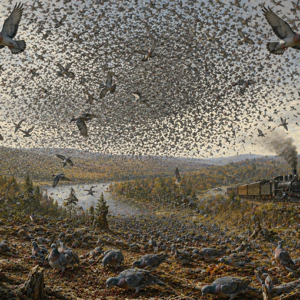
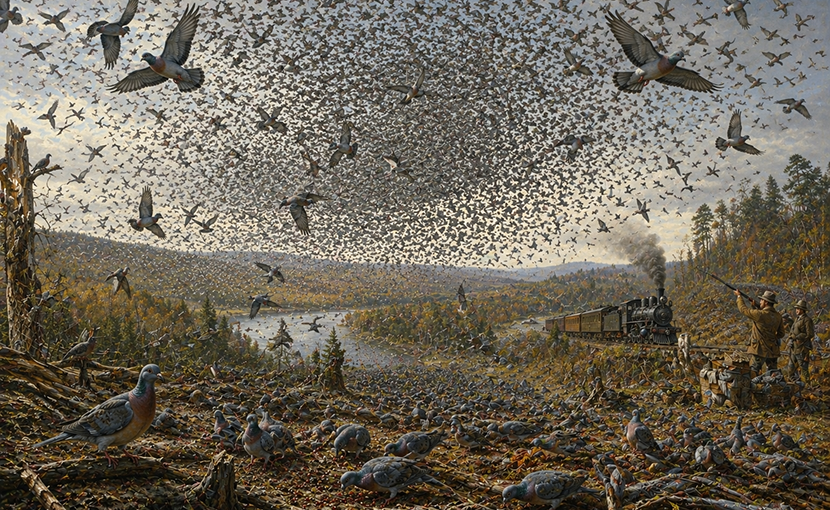
Once, the skies of North America
were filled with birds in numbers so vast
they darkened the sun.
Their name was the passenger pigeon.
Their flocks were said to number in the billions.
They shook forests,
covered the ground in shadow,
and passed overhead for days at a time.
They were considered
too abundant to vanish.
And because of that,
almost no one believed
they could ever go extinct.
Basic Information
| Classification | Aves / Columbiformes / Columbidae |
|---|---|
| Scientific name | Ectopistes migratorius |
| Time period | Holocene–1914 |
| Geographic range | Eastern North America |
| Body length | ~40 cm |
| Diet | Nuts, seeds, and fruits |
| Distinctive traits | Massive flocking behavior, long-distance migration, colony-dependent breeding |
One of the Largest Bird Populations in Earth’s History
The passenger pigeon was not merely common.
Estimates suggest that:
between 3 and 5 billion individuals
may once have existed.
At the time, they may have represented
a substantial proportion of all birds in North America.
Historical accounts describe how:
- skies darkened as flocks passed,
- branches snapped beneath their weight,
- droppings covered entire landscapes.
Why Were They So Successful?
Passenger pigeons thrived because of:
- vast forest resources,
- enormous migratory ranges,
- protection through overwhelming numbers.
Most importantly:
the flock itself was their survival strategy.
Industrialization Made Mass Killing Possible
In the 19th century,
humanity gained new tools of extraction:
- railroads,
- telegraph communication,
- industrial-scale firearms,
- commercial transport networks.
Together, these innovations enabled something new:
the locations of flocks could be shared instantly,
and mass slaughter became industrialized.
The Illusion of Infinite Numbers
There were simply too many pigeons.
Because of this:
- few perceived any danger,
- regulation came too late,
- commercial hunting continued unchecked.
Their abundance created the illusion
that they could never run out.
Habitat Destruction Happened at the Same Time
Hunting alone did not cause their extinction.
At the same time:
- forests were cleared,
- farmland expanded,
- breeding habitats disappeared.
The environmental conditions required
to sustain enormous flocks
collapsed rapidly.
The Weakness of a Species Built on Numbers
Passenger pigeons appear to have depended heavily on:
- dense colonies for breeding success,
- large-scale social behavior.
This created a fatal dynamic:
the fewer they became,
the harder survival became.
Decline accelerated itself.
The Last Individual
In 1914,
at the Cincinnati Zoo,
the last known passenger pigeon—Martha—died.
A species once counted in the billions
was gone
within only a few decades.
Why This Extinction Matters
The extinction of the passenger pigeon is unusual because it occurred:
- not on an isolated island,
- but across a vast continent,
- to one of the most numerous birds on Earth.
Its story reveals a difficult truth:
abundance does not guarantee survival.
The passenger pigeon did not disappear because it was weak.
Nor because it was rare.
If anything,
it was too abundant.
Its overwhelming numbers convinced humanity
that decline was impossible.
The modern era marked the moment
humans first gained the power to eliminate
even lives that seemed endless.