Japanese | English
– The Fate of a Predator That Never Learned to Fear Humans –
The Falkland Islands Wolf (Warrah)
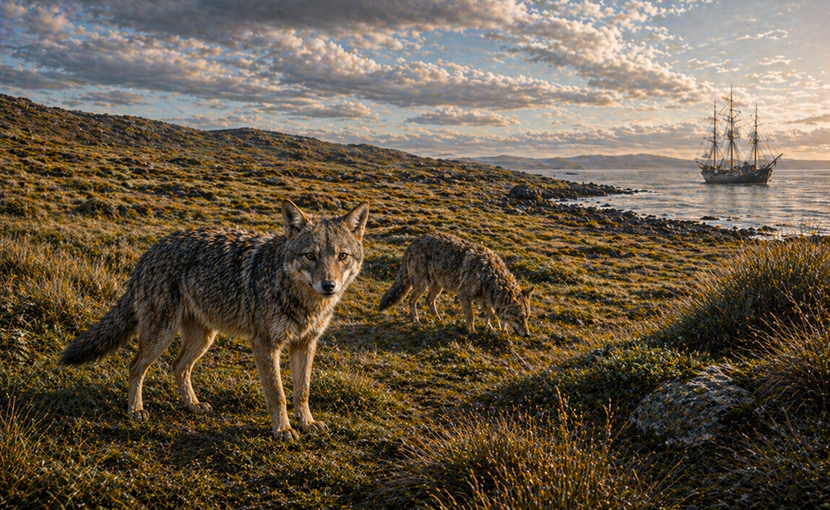
On a remote archipelago in the South Atlantic—the Falkland Islands—
there once lived a single species of land predator.
It was the Falkland Islands wolf, also known as the warrah.
Evolved in isolation,
it stood at the top of its ecosystem.
Yet unlike most predators,
it did not fear humans.
And that absence of fear
determined its fate.
Basic Information
| Classification | Mammalia / Carnivora / Canidae |
|---|---|
| Scientific name | Dusicyon australis |
| Time period | Holocene–1876 |
| Geographic range | Falkland Islands (endemic) |
| Body length | ~90 cm |
| Diet | Carnivorous (birds, small animals) |
| Distinctive traits | Only native terrestrial predator, lack of fear toward humans |
An Isolated Predator
The Falkland Islands ecosystem was extremely simple:
- almost no other land mammals,
- minimal competition,
- no large external threats.
Within this system, the warrah occupied
the apex position.
But that position existed
in complete isolation from the wider world.
A Predator That Did Not Flee
Predators are typically cautious.
The warrah was not.
- It approached humans
- It did not perceive humans as a threat
- It lacked avoidance behavior
This was not abnormal.
It was the natural outcome of evolution
in an environment without danger.
Encounter with Humanity
In the 18th and 19th centuries,
European settlers arrived on the Falkland Islands.
At that moment,
the warrah’s world collapsed.
- hunting for fur,
- killing to protect introduced sheep,
- trapping as a routine practice.
The warrah was not eliminated as a dangerous predator,
but as something even more vulnerable:
an animal that was easy to kill.
An Uncomplicated Extinction
The extinction of the warrah was not complex.
- it did not flee,
- it reproduced slowly,
- it encountered humans.
That alone
was sufficient.
Even Apex Predators Are Not Exempt
The warrah was not prey.
It was an apex predator.
And yet it vanished.
This reveals a critical truth:
strength is irrelevant—
adaptation to humans determines survival.
Why This Case Is Symbolic
The warrah represents one of the rare cases of
a predator that did not fear humans.
Its extinction demonstrates that:
- predators are not inherently protected,
- intelligence without adaptation is insufficient,
- isolation does not guarantee survival.
The Fragility of Island Systems
The Falkland Islands were:
- small,
- closed,
- ighly sensitive to external disturbance.
Once humans intervened,
there was almost no capacity for recovery.
The warrah was not defeated.
It never fought.
It did not know it had an enemy.
And that alone
was enough to ensure its extinction.
The Age of Exploration connected isolated worlds.
At the same time,
it systematically erased the lives
that had been protected by that isolation.