

Japanese | English
– Their Ecological, Agricultural, and Societal Value –
Abstract
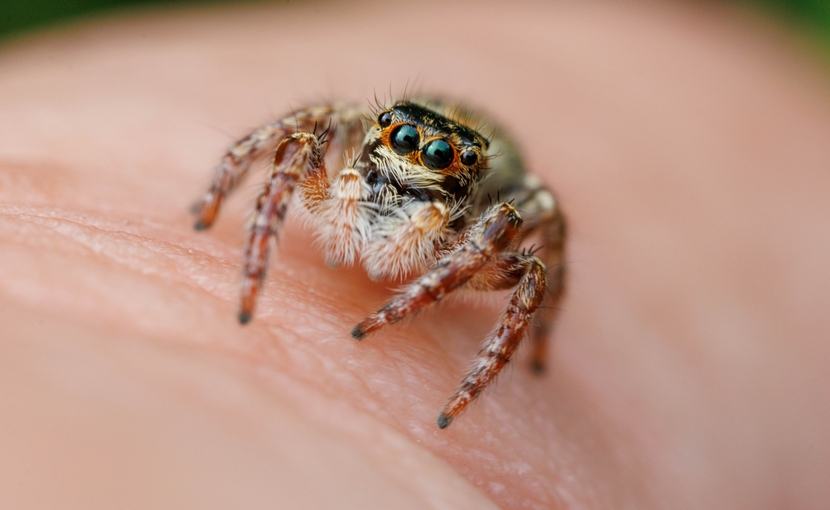
Spiders are often regarded with aversion or fear and are frequently misclassified as pests in human environments. However, from ecological, agricultural, and public health perspectives, spiders consistently provide beneficial services. This paper argues that spiders should be recognized as universally beneficial organisms due to their role as natural pest controllers, stabilizers of ecosystems, and non-harmful cohabitants of human living spaces. By examining their predatory function, ecosystem services, and actual impact on humans, this study demonstrates that spiders produce net positive effects without imposing direct or indirect harm.
1. Introduction
Organisms that enter human living spaces are commonly evaluated through emotional responses rather than empirical criteria. Spiders are a representative example: despite widespread discomfort toward their appearance, they are routinely labeled as undesirable or harmful.
Scientifically, however, an organism should be considered a pest only if it causes tangible damage to human health, resources, or infrastructure. This paper reassesses spiders based on this functional definition, rather than cultural or psychological bias.
2. Predatory Function of Spiders
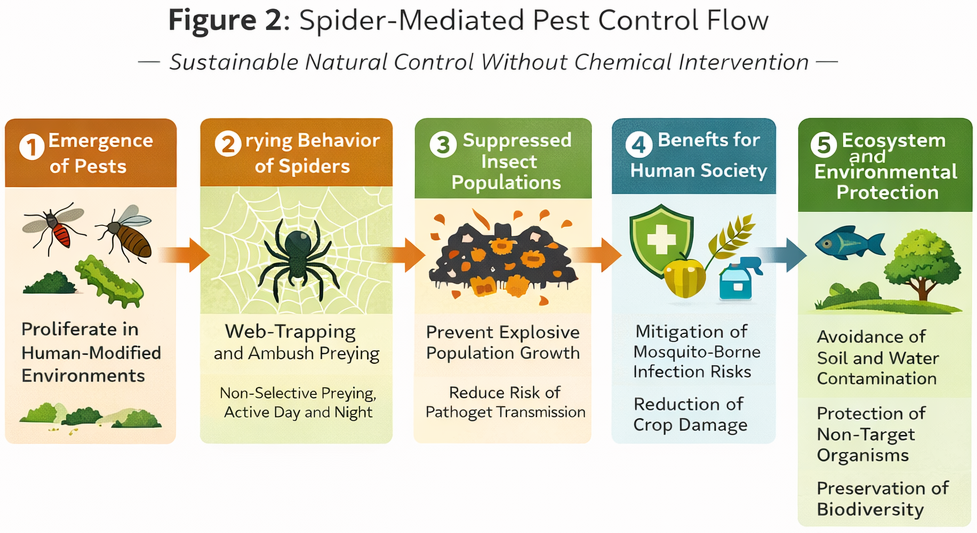
Spiders are obligate carnivores whose diet primarily consists of insects that humans generally regard as pests, including:
- Mosquitoes and flies
- Cockroaches
- Agricultural pest insects such as aphids and caterpillars
Unlike chemical insecticides, spiders exert continuous and localized control over insect populations through web-based trapping and ambush predation. Their hunting behavior does not disrupt non-target organisms indiscriminately, making them an ecologically precise form of population regulation.
3. Ecosystem Services Provided by Spiders
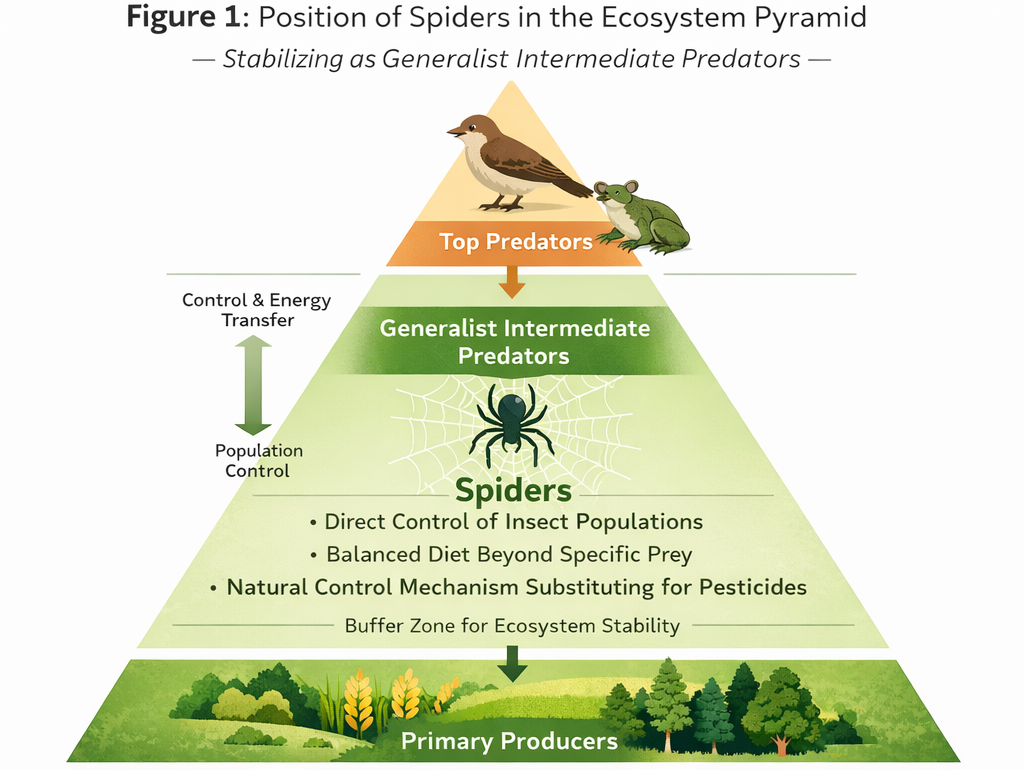
Beyond individual predation, spiders play a critical role in maintaining ecosystem stability:
- Suppression of insect population outbreaks
- Regulation of energy flow within food webs
- Contribution to biological pest control in agricultural systems
Numerous ecological studies indicate that environments with abundant spider populations experience reduced pest damage and lower dependency on chemical pesticides. The removal of spiders, conversely, often results in trophic imbalance and increased agricultural loss.
4. Impact on Human Health and Living Environments
Fear of spider venom or biting is a primary factor behind their negative reputation. However, empirical evidence demonstrates that:
- The vast majority of spider species in temperate regions are harmless to humans
- Spiders do not actively attack humans
- Documented spider bites are rare and typically medically insignificant
Moreover, spiders do not damage food supplies, buildings, or household materials. This absence of direct harm distinguishes spiders from true household pests such as termites or rodents.
5. Psychological Aversion versus Scientific Assessment
Human aversion to spiders is largely attributable to evolutionary fear responses and cultural narratives rather than factual risk. When evaluated objectively, spiders meet all criteria of beneficial organisms:
- They reduce populations of harmful insects
- They cause no measurable harm to humans
- They support ecological balance across multiple environments
Thus, labeling spiders as pests reflects cognitive bias rather than biological reality.
6. Conclusion
Spiders function as:
- Natural regulators of pest populations
- Stabilizing agents within ecosystems
- Non-destructive inhabitants of human environments
On the basis of ecological function and empirical evidence, spiders should be regarded as universally beneficial organisms. Their unnecessary removal represents not a protective measure, but a disruption of natural systems that ultimately disadvantages human society. Rational coexistence with spiders constitutes a scientifically sound and environmentally sustainable choice.
Spiders exemplify organisms that perform essential ecological roles while remaining misunderstood and undervalued. Their presence challenges human tendencies to judge nature through fear rather than function, reminding us that ecological value is not determined by appearance, but by contribution.






コメント