

Japanese | English
The Beginning: Within Circulating Air
The morning in the city center was, as always, ordinary.
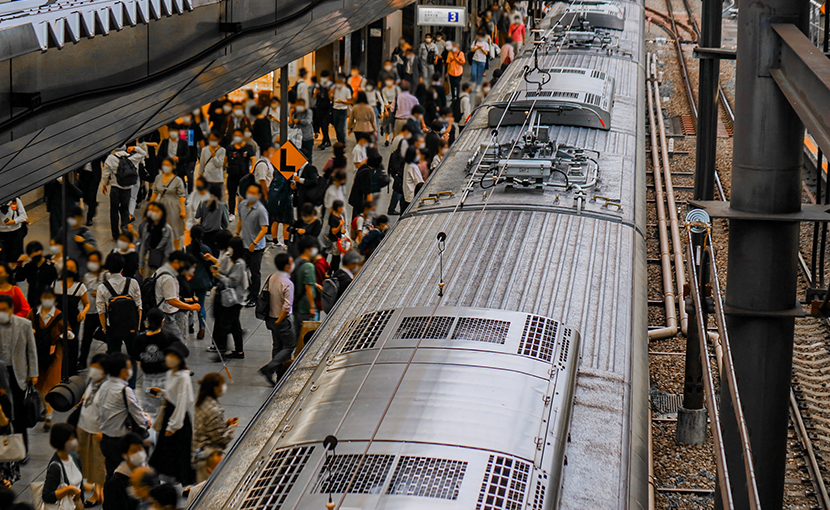
A train slid into the underground platform. When the doors opened, people flowed into the car, pushing and pressing against one another. Suits, coats, bags, damp breaths. Body heat blended together, and the outlines of individuals quickly dissolved. No one spoke. Everyone faced the same direction, intent on not being late for the same hour.
Inside the car, the air-conditioning hummed softly, continuing its circulation.
Air cooled, filtered, and expelled again. No one was conscious of its movement.
Even if there had been a slight anomaly that day, no one noticed it.
Deep within the air-conditioning filter, in a dark space long left uncleaned, microscopic life had become active. The vibrations of the city, humidity, temperature, nutrients—by chance, all the conditions had aligned.
The train departed, and people repeated the cycle of boarding and disembarking at each station.
Each time, the same air was shared, and the same particles were carried into their lungs.
For the first few days, no one thought it was an illness.
A mild fever, fatigue, a cough. Common enough for a change of seasons. People went to work, went to school, boarded other trains, and moved on to other parts of the city.
The infection was spreading.
But there was still no one calling it “infection.”
Before long, reports of deaths began to appear.
Unknown causes. Rapid deterioration. Treatments unable to keep pace. These phrases filled the news headlines. Hospitals overflowed with people, lines formed in search of medicine. Everyone shared the same unspoken question—had they already inhaled it?
The government issued statements, convened expert panels, and promised countermeasures.
But the numbers did not stop. Transmission routes could not be identified, containment failed, and the city was gradually enveloped in a quiet fear.
The crowded trains continue to run today.
The air-conditioning continues, unchanged, to circulate the air.
At last, people begin to realize:
this city was never theirs alone.
Invisible life had been there all along,
waiting quietly for its opportunity within the order humans had built.
(Why This Story Holds Together)
This event has neither a hero nor a clearly identifiable perpetrator.
It is not a deliberate attack, nor is it a mere accident. Rather, it is a structural consequence woven over time by the interaction between an artificial environment—the city—and a form of life—microorganisms.
The crowded trains, air-conditioning systems, human mobility, medical collapse, and the faltering of governance, as presented in the story, function only as narrative devices to evoke emotion. The question that truly demands examination is why this chain of events feels so plausible—why it coheres so convincingly as a story.
From a life-science perspective, the city is not a neutral backdrop but an environment that generates selective pressures. Urban infrastructure, built through the human pursuit of efficiency and comfort, can ultimately function as a mechanism of dispersal for microorganisms. No intention is required. All that is necessary is that the conditions align.
In the essay that follows, this fictional pandemic is treated as an allegory through which the relationship between urban civilization and microorganisms is examined from a biological perspective. The subject is not fear. It is an attempt to quietly unsettle the assumptions on which humanity has spoken of “control” and “dominance,” by reconsidering where humans stand within the broader biosphere.
The City Seen from a Microbial Perspective
– Biological Implications of a Fictional Pandemic –
The city is humanity’s largest ecosystem.
Yet its principal inhabitants are not necessarily human.
This essay examines a fictional pandemic triggered by contamination in the air-conditioning systems of crowded commuter trains in a metropolitan center. It does not seek to reproduce or model any real infectious disease; rather, it is conceived as an allegory intended to stimulate biological reflection. Even so, the trajectory it describes arrives at conclusions that feel strikingly “natural” from a life-science perspective.
Urban Infrastructure as Culture Medium
From a microbial point of view, a crowded commuter train is an ideal culture system.
Temperature is regulated, humidity remains stable, and nutrients—human-derived aerosols—are continuously supplied. The air-conditioning system functions as an agitator, evenly dispersing microorganisms throughout the enclosed space.
Humans call this activity “commuting.”
For microorganisms, it is merely a dispersal phase.
What matters is that this spread does not arise from malice or accident, but emerges spontaneously from a society optimized for rationality. Urban structures designed for efficiency inadvertently create environments that are evolutionarily advantageous for microorganisms.
The Strategy of the Mobile Host
Infected individuals move—
rapidly, widely, and without awareness.
From a biological standpoint, few dispersal strategies are as effective. Humans believe they move by their own will, yet in doing so they facilitate the geographic expansion of microorganisms. Intercity travel and international mobility function as long-distance transport systems, enabling microbes to overcome evolutionary bottlenecks with ease.
At this point, the grammatical subject has already reversed.
It is not that “humans carry pathogens.”
It is that “pathogens use humans to move.”
Medicine and the Problem of Time
As the pandemic progresses, human society attempts to respond through medicine. Here, however, a decisive temporal gap becomes apparent. Microorganisms reproduce on the scale of minutes; medical systems respond on the scale of months or years.
Patients who rush to hospitals in search of treatment behave in ways that are biologically understandable. Yet those very actions increase contact frequency and generate new opportunities for transmission. Medical institutions may serve as breakwaters, but they can also become new nodes of connectivity.
This is not a failure of medicine.
It is an inevitable asymmetry produced by differences in evolutionary speed.
Ungovernability as a Biological Outcome
Governmental dysfunction is often framed as a political failure. In this scenario, however, it is depicted as a biological inevitability. Governance requires information gathering, deliberation, and execution—each a process that consumes time.
Microorganisms, by contrast, do not deliberate.
They simply multiply.
Confronted with this asymmetry, even the most sophisticated institutions lose their capacity for rapid response. Humanity is forced to recognize that its civilization is, within the biosphere, an exceptionally slow entity.
The Hypothesis of Microbial Dominance
The core claim of this essay can be condensed into a single sentence:
We humans are dominated by microorganisms.
This is not dominance in a conspiratorial sense. It is dominance as an outcome—exerted by entities without intention or purpose. Microorganisms do not plan. Yet the structure of human society itself has evolved in ways that favor them.
Cities, transportation networks, medical systems, globalization—
all are symbols of human prosperity, and at the same time, optimal environments for microbial life.
Conclusion
This fiction is not a pessimistic tale meant to expose human fragility. Rather, it is a biological allegory that invites reconsideration of how deeply life is interdependent and governed by logics that are not human.
We are not at war with microorganisms.
We coexist with them as part of this planet’s ecosystem.
When that fact is forgotten, the city becomes both the most refined product of civilization and its most vulnerable experimental apparatus.










コメント