Japanese | English
– The Wild That Could Not Be Controlled, and the Wild Controlled to Death –
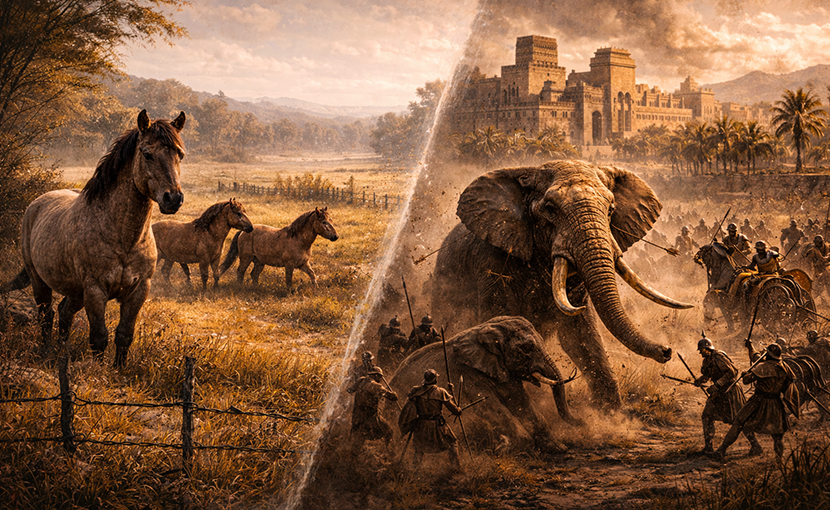
Tarpan × Syrian Elephant
From the Neolithic age into antiquity,
humanity transformed from a species that hunted
into a species that managed life itself.
That management, however, did not always preserve.
Some wild beings vanished because they could not be controlled.
Others vanished because they were controlled too completely.
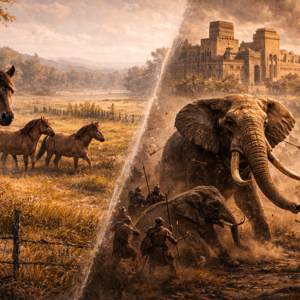
The tarpan and the Syrian elephant stand at opposite ends of this spectrum.
Two Forms of Wildness, Two Opposite Fates
- The Tarpan
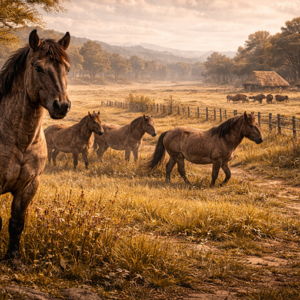
A wild horse that resisted domestication
A life form that never integrated into human society
- The Syrian Elephant
A giant absorbed into state power and symbolism
A species systematically managed, hunted, and consumed
Both were ecologically successful.
Both were biologically complete.
Yet both were judged, by human society,
to be inconvenient.
The Uncontrollable Wild: The Tarpan
The tarpan lived alongside humans
without ever becoming part of their world.
- It was not docile.
- It could not be confined.
- It refused permanent control.
As agriculture and settlement expanded,
these traits ceased to be valued as wildness.
They became obstacles.
The tarpan was eliminated
not for what it destroyed,
but for what it refused to become.
Wildness itself became the offense.
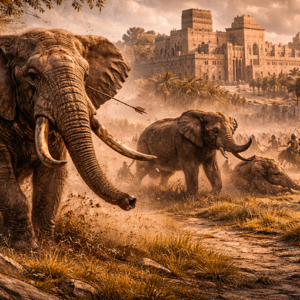
The Overmanaged Wild: The Syrian Elephant
The Syrian elephant followed the opposite path.
It was drawn deeply into human systems:
- as a symbol of royal authority,
- as a source of ivory,
- as a target of state-organized hunts.
It was feared, celebrated, and exploited.
Yet its survival was never considered.
Because it was valuable,
it was consumed without limit.
This was wildness destroyed not by rejection,
but by excessive integration.
The Shared Mechanism
Despite their differences,
the extinction of both species shares a single cause:
They were judged not by ecological necessity,
but by human social logic.
- Can it be controlled?
- Can it be used?
- Can it reinforce power?
When the answer was “no” or “not enough,”
wild life lost its right to exist.
The Nature of Post-Neolithic Extinction
If Paleolithic extinctions were largely unintended,
Neolithic and ancient extinctions were chosen.
Humanity began to decide:
- which wild beings would remain,
- which would be reshaped,
- and which would disappear.
This was a fundamental shift.
Life was no longer encountered.
It was classified and managed.
A Line That Extends to the Present
This structure did not end in antiquity.
Even today:
- uncontrollable animals are removed,
- controllable animals are exploited beyond recovery.
Wildness is still forced into a binary choice:
submit—or vanish.
The tarpan and the Syrian elephant were simply among the first.
The tarpan remained wild until the end.
The Syrian elephant remained useful until the end.
Neither extinction was a failure of nature.
They were the result of
human decisions about how the world should be organized.
The Neolithic age was when those decisions first became clear.
And once made,
they have never truly stopped being made.