Japanese | English
– When Predators Lost Their Prey –
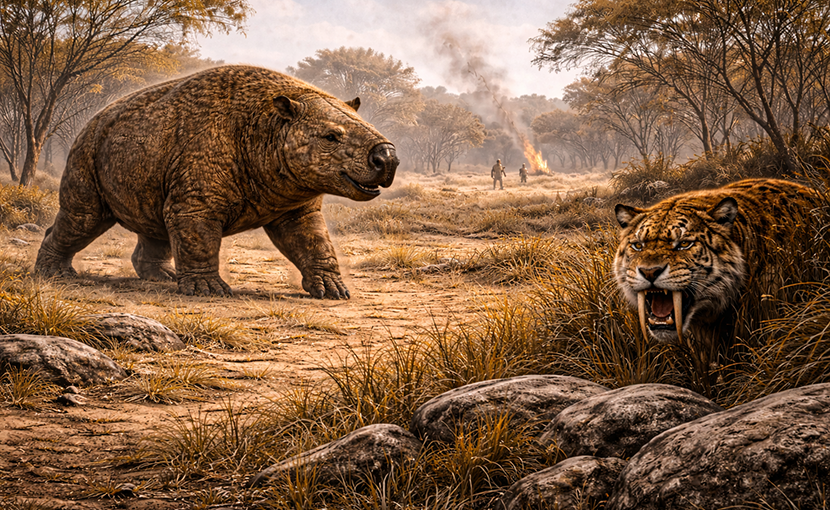
Diprotodon × Saber-Toothed Tiger (Smilodon)
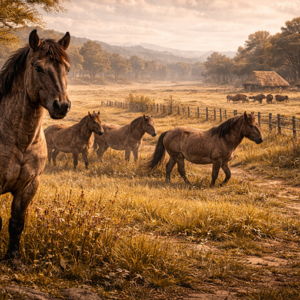
In a world shaped by giant herbivores,
there were predators built to hunt them.
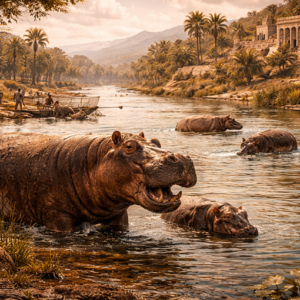
Where Diprotodon walked the land,
the saber-toothed tiger lurked in the shadows.
They were adversaries—
yet at the same time,
they were interdependent components of the same ecosystem.
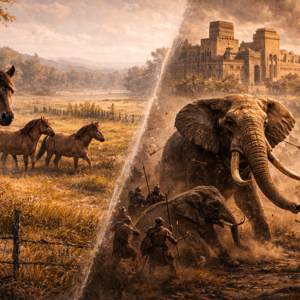
That balance collapsed with a single arrival:
humanity.
When One Vanishes, the Other Follows
An ecosystem is not a collection of isolated species.
It is a web of relationships:
- herbivores,
- predators,
- vegetation,
- landscape.
Diprotodon consumed vast quantities of plant matter,
shaping vegetation and maintaining open environments.
The saber-toothed tiger regulated those giants,
selecting the weak and maintaining population turnover.
Remove either one,
and equilibrium fails.
Which One Did Humans Erase?
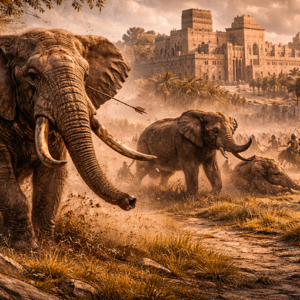
Humans erased Diprotodon first.
Through:
- direct hunting,
- landscape modification with fire,
- control of water sources and migration routes.
The giant herbivore declined slowly,
but irreversibly.
The saber-toothed tiger was not hunted to extinction.
Yet:
- prey disappeared,
- hunting grounds fragmented,
- high-calorie kills became impossible.
Under these conditions,
survival was no longer viable.
Predators Die Last
In collapsing ecosystems,
predators are usually the last to disappear.
Not because they are stronger—
but because their food sources persist for a time.
Once those foundations vanish completely,
predators collapse rapidly.
The extinction of the saber-toothed tiger signals that
the ecosystem had already failed.
Why Adaptation Was Impossible
The saber-toothed tiger could not shift to small prey.
- Its elongated canines were fragile.
- Its hunting strategy depended on large-bodied animals.
- Its social and anatomical design assumed massive energy returns.
This was not a flaw.
As long as Diprotodon existed,
this strategy was optimal.
Humanity Did Not Reduce Numbers — It Removed Recovery
The crucial point is this:
humans did not merely reduce prey populations.
They:
- hunted,
- burned,
- restricted movement,
- prevented regeneration.
Humanity eliminated the ecosystem’s capacity to recover.
For predators, this was fatal.
Two Extinctions, One Cause
Diprotodon and the saber-toothed tiger disappeared:
- in the same era,
- for the same underlying reason,
- through different mechanisms.
- Herbivores died directly.
- Predators died indirectly.
The cause was singular:
the emergence of a species that acted on the ecosystem as a whole.
A Quiet Warning for the Present
The same pattern repeats today.
Large herbivores decline.
Predators vanish soon after.
Ecosystems simplify and lose resilience.
We already know this truth:
When apex predators disappear,
the system is already near collapse.
When Diprotodon vanished,
the fate of the saber-toothed tiger was sealed.
Predators cannot exist without prey.
And humanity—
already in the Paleolithic—
possessed the power to erase both at once.
Extinction-related book