Japanese | English
– A Marsupial Too Perfectly Adapted to the Land –
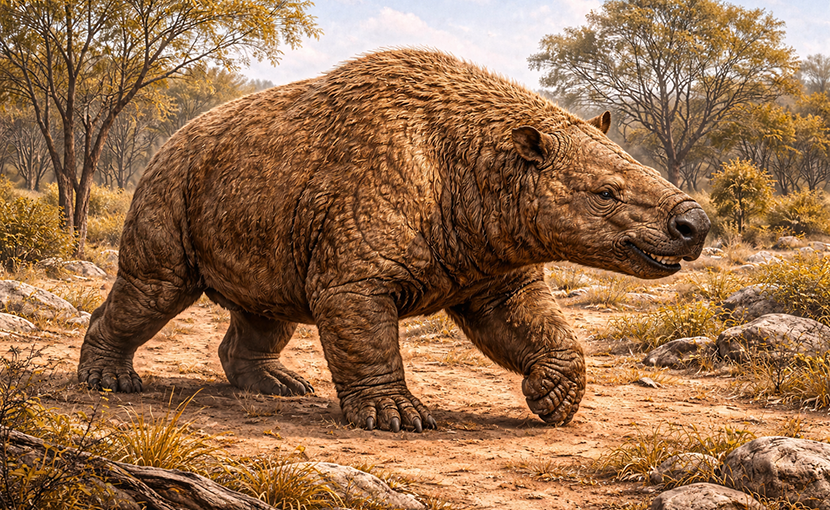
Nototherium
Once, across the Australian continent,
there lived a herbivore so large that it scarcely resembled a marsupial at all.
Its name was Nototherium.
A close relative of Diprotodon, this massive animal quietly but firmly occupied the landscapes of Pleistocene Australia.
Its fate, however, was sealed by a single encounter:
the arrival of humans.
Basic Information
| Classification | Marsupial (Diprotodontia / Diprotodontidae) |
|---|---|
| Time period | Pleistocene (approx. 2 million–40,000 years ago) |
| Geographic range | Australia |
| Body length | ~3–4 meters |
| Estimated weight | Up to ~1 metric ton |
| Diet | Herbivorous |
| Distinctive traits | Large, robust body; powerful forelimbs; low center of gravity |
What Nototherium Was
Nototherium was highly specialized for Australia’s dry and variable environments.
It possessed:
- teeth capable of grinding tough vegetation,
- a stable, weight-bearing body adapted for long-distance foraging,
- physiological tolerance to limited water availability.
These were not crude traits, but the result of long and successful evolutionary refinement.
It was not fast.
But it had never needed to be.
The Path to Extinction
During most of its existence, Nototherium faced no consistent predators capable of hunting it.
That changed around 50,000–60,000 years ago, when modern humans arrived in Australia.
Soon after, Nototherium—along with much of Australia’s megafauna—disappeared within a relatively short span of time.
Evidence includes:
- a rapid decline in fossil abundance,
- close temporal overlap with human arrival,
- widespread signs of landscape modification through fire.
Together, these patterns suggest that human influence was a decisive factor.
Why Humans Were Decisive
Nototherium did not recognize humans as predators.
- It lacked any evolutionary memory of bipedal hunters.
- Its reproductive rate was slow.
- Its wide range was vulnerable to fragmentation.
Humans introduced pressures the ecosystem had never experienced:
- coordinated hunting,
- the deliberate use of fire to alter landscapes.
Even when Nototherium was not directly hunted,
its habitat was transformed beyond viability.
What Nototherium’s Extinction Reveals
Its disappearance marks a turning point:
humans were no longer merely predators,
but architects of ecological transformation.
A Giant Lost with the LandNototherium was not poorly adapted.
It was, in many ways, an evolutionary success.
Yet it could not withstand a species capable of changing the environment itself.
Nototherium did not fall in battle.
It was not outpaced or outcompeted.
Instead,
the assumptions of its world changed.
And when the world changed,
there was no place left for it.
Extinction-related book