Japanese | English
– When Armor Was Not Enough –
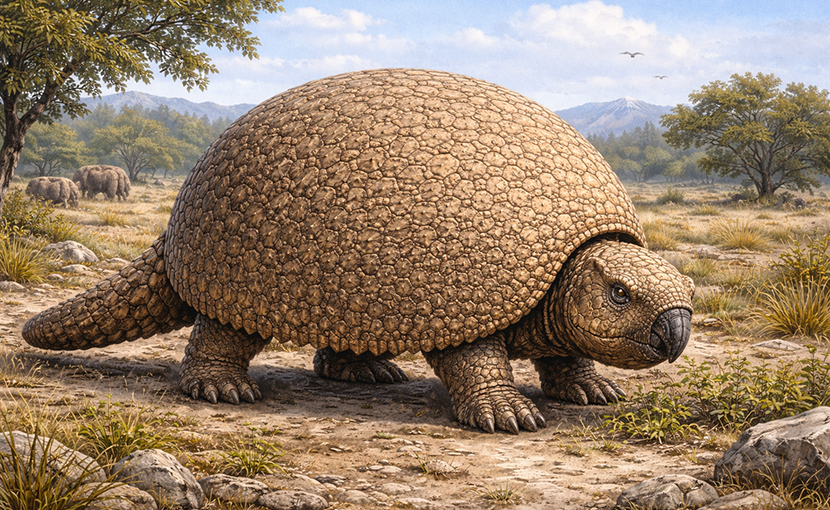
Glyptodon
Once, across the grasslands of South America,
there walked a creature that resembled a living fortress.
Its name was Glyptodon—
a massive herbivore encased in a shell of bone, seemingly untouchable by predators.
And yet, that armor proved powerless against one encounter:
humanity.
Basic Information
| Classification | Cingulata (close relatives of modern armadillos) |
|---|---|
| Time period | Pleistocene (approx. 2 million~10,000 years ago) |
| Geographic range | Primarily South America |
| Length | ~3 meters |
| Weight | Up to and exceeding 2 metric tons |
| Diet | Herbivorous |
| Distinctive features | Full-body bony armor; club-like tail in some species |
Armor as an Evolutionary Endpoint
Glyptodon followed a remarkably clear evolutionary strategy:
- Do not flee
- Do not hide
- Do not fight
Instead—be unbreakable.
Its shell, formed from thousands of fused bony plates,
could withstand the bites and claws of the largest carnivores of its time.
Within its ecosystem, Glyptodon was effectively invulnerable.
The Path to Extinction
For hundreds of thousands of years, Glyptodon held a stable position in South American ecosystems.
That balance shifted around 10,000 years ago, when modern humans reached the continent.
Fossil evidence reveals:
- bones bearing stone-tool cut marks,
- patterns consistent with human butchery and processing.
The armor itself was rarely shattered.
Humans did not need to break it—
they understood where it was soft.
Why Armor Failed
Glyptodon’s defenses were designed for predators that attacked head-on.
Humans were different.
They hunted with:
- knowledge and observation,
- tools and weapons,
- coordinated group tactics.
By overturning the animal, targeting the belly or neck, or selecting weakened individuals,
humans rendered armor irrelevant.
Against strategy, protection alone was meaningless.
What Glyptodon’s Extinction Reveals
Glyptodon was not an evolutionary failure.
It was, in many ways, a perfected defensive organism.
Yet it could not adapt to a predator defined by intelligence rather than strength.
This extinction demonstrates a stark truth:
power, size, and armor do not guarantee survival.
The environment did not simply change.
The rules changed.
A Question Left Inside the Shell
Glyptodon lived in a world where it was protected.
That was the only world it knew.
Into that world arrived something entirely new.
A life that armor could not save—
a quiet but decisive turning point in Earth’s history,
marked by humanity’s arrival.
Extinction-related book