Japanese | English
– Apex Predators Driven from the Water –
Crocodiles (Removal from the Mediterranean World)
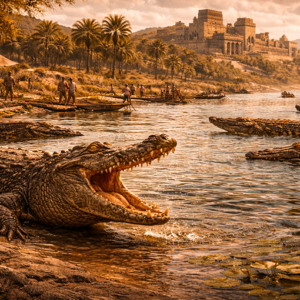
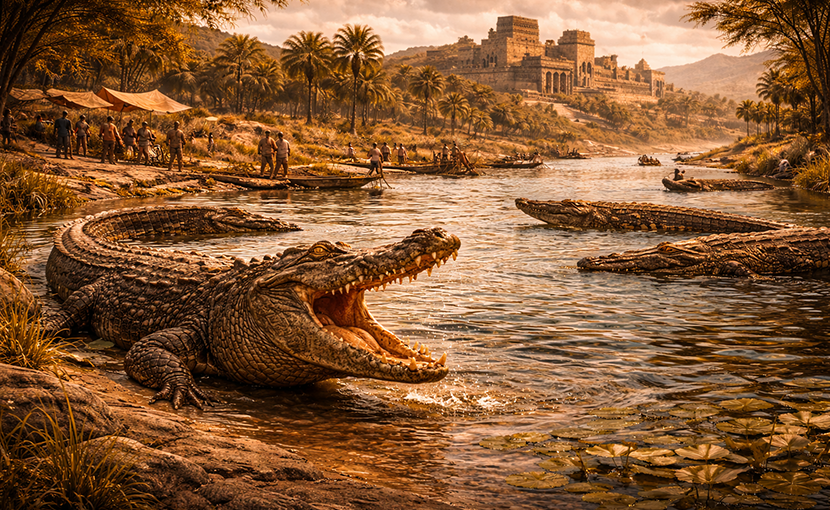
Once, the rivers and wetlands of the Mediterranean world
were inhabited by crocodiles.
This is not myth or symbolism.
Archaeological records and ancient texts indicate that crocodiles truly lived along Mediterranean and Near Eastern waterways.
They are not extinct.
And yet,
they were completely removed from the Mediterranean world.
What followed was not ecological chance,
but a collision between civilization and wildness at the water’s edge.
Basic Information
| Classification | Reptilia / Crocodylia |
|---|---|
| Relevant species | Nile crocodile (Crocodylus niloticus) and related populations |
| Time period | Late Pleistocene–Antiquity |
| Former range | North Africa, the Levant, Mediterranean river systems |
| Current range | Primarily sub-Saharan Africa |
| Body length | Up to 5 meters or more |
| Diet | Carnivorous |
| Distinctive traits | Semi-aquatic apex predator, extreme danger to humans |
A Predator of Mediterranean Waters
During the Late Pleistocene and early Holocene,
the Mediterranean region was far wetter than it is today.
- Rivers flowed steadily
- Wetlands were widespread
- Humans and animals shared riverbanks
These conditions made the region ideal habitat for crocodiles.
They were among the top predators of the water.
A Fatal Overlap with Human Needs
The habitats crocodiles require
are the same spaces civilization depends on most:
- drinking water
- irrigation
- transport routes
- fertile agricultural land
In other words,
the foundation of settled life.
Here, coexistence proved impossible.
Too Dangerous to Tolerate
Crocodiles:
- cannot be domesticated,
- actively prey on humans,
- make water use unpredictable and dangerous.
For settled societies, this was unacceptable.
Waterways had to be controlled.
To control them,
unpredictable predators had to be removed.
Removal Was Deliberate
The disappearance of crocodiles was not accidental.
It resulted from:
- sustained culling,
- drainage of wetlands,
- straightening and regulation of rivers,
- complete human appropriation of waterways.
Ancient Egyptian reliefs depict crocodile hunting and subjugation—
clear evidence that removal was intentional and systematic.
Why Crocodiles Survived in Africa
As with hippopotamuses and lions,
survival was not a matter of strength.
It depended on space.
- vast river systems,
- wetlands beyond full control,
- limits to population density and infrastructure.
Where humans could not fully dominate water,
crocodiles endured.
Crocodiles were powerful.
But civilization reshaped the environment itself.
What This Local Extinction Reveals
Crocodiles were not removed because they were useless.
They were removed because they were too dangerous
and incompatible with managed landscapes.
Their disappearance marks
the moment humans claimed absolute control over water.
A Line That Extends to the Present
Today, crocodiles are seen as icons of untamed wilderness.
But this image exists only because
they were expelled from the heart of civilization.
The absence of crocodiles from Mediterranean rivers
is evidence that humanity seized control
of nature’s most critical corridors.
Crocodiles did not vanish.
They were excluded.
Excluded from the rivers, wetlands, and floodplains
that civilization decided to own.
This exclusion marks one of the clearest boundaries
humanity ever drew between itself and wild life.