Japanese | English
– When the Wild Lost Its Place in a Tamed World –
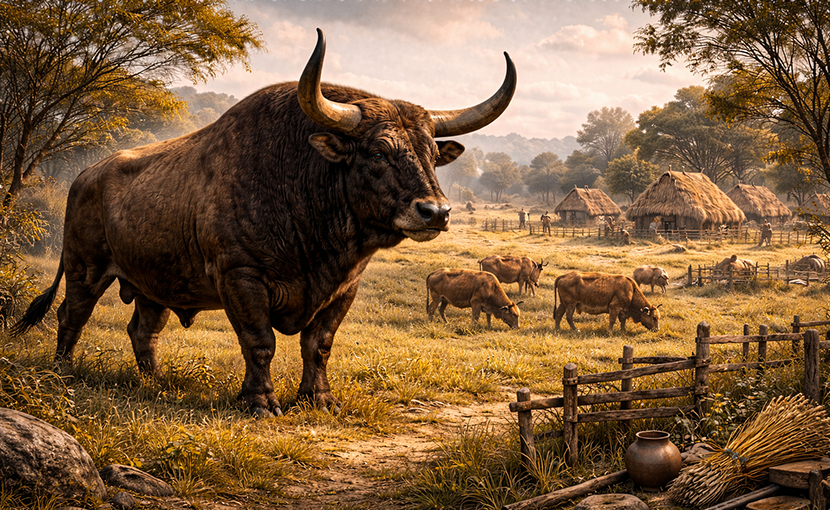
The Aurochs (Bos primigenius)
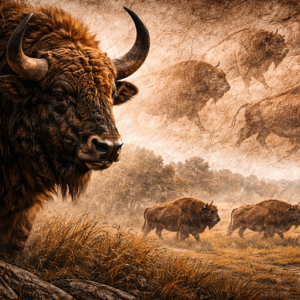
Once, across Europe, Western Asia, and the Indian subcontinent,
a massive wild bovine thundered across open land.
Its name was the aurochs (Bos primigenius).
It was the direct ancestor of modern cattle—
and at the same time, one of the first wild animals humanity erased through domestication.
The aurochs did not vanish simply because it was hunted.
It disappeared because wildness itself became unnecessary.
Basic Information
| Classification | Mammalia / Artiodactyla / Bovidae |
|---|---|
| Time period | Late Pleistocene–Early Modern Era (approx. 2 million years ago–1627 CE) |
| Geographic range | Europe, Western Asia, South Asia |
| Shoulder height | ~180–200 cm (males) |
| Body mass | Up to ~1 metric ton |
| Diet | Herbivorous |
| Distinctive traits | Massive body, long forward-curving horns, highly aggressive temperament |
A Wild Animal Perfected
Before agriculture, the aurochs was a fully realized large herbivore.
It possessed:
- high mobility,
- formidable defensive strength,
- herd-based social behavior,
- resilience to harsh and variable environments.
To predators—and even to early humans—
the aurochs was not an easy target.
A Shift in the Human Relationship
In the Paleolithic,
aurochs were dangerous yet valuable prey.
With the Neolithic Revolution, everything changed.
As humans adopted agriculture and permanent settlement,
the aurochs was redefined:
- a destroyer of crops,
- a competitor to livestock,
- an uncontrollable remnant of the wild.
It shifted from hunted animal to eliminated obstacle.
Domestication as a Turning Point
Some aurochs were selectively bred by humans—
smaller, calmer individuals chosen generation after generation.
From these lineages emerged modern cattle.
But domestication was not coexistence.
- The wild type was deemed unnecessary.
- Aggressive individuals were removed.
- Landscapes were converted into farmland.
Humanity preserved the descendant—and erased the original.
A Long, Silent Decline
The extinction of the aurochs was not sudden.
It unfolded over centuries through:
- habitat fragmentation,
- agricultural expansion,
- sustained hunting pressure,
- diseases transmitted from domestic cattle.
The last recorded aurochs died in 1627, in Poland.
Its extinction occurred not in prehistory,
but within documented human history.
Why the Aurochs Matters
The aurochs did not disappear because humans failed to control nature.
It vanished because humans chose to eliminate
wildness that could not be controlled.
This was not accidental extinction.
It was systematic exclusion.
The Neolithic Turning Point
Unlike Paleolithic extinctions,
the loss of the aurochs reflects a different kind of human impact:
- unconscious pressure → deliberate management
- incidental collapse → planned transformation
Here, humanity crossed a threshold—
from being part of nature
to acting as its manager.
What Remains After the Wild Is Gone
Modern cattle are indispensable to human society.
Yet behind them stands a vanished form—
a wild animal that will never return.
The aurochs was both the ancestor of livestock
and the first wild being humanity chose to deny.
The aurochs did not lose a battle.
It simply became unnecessary
in a world reshaped for human needs.
At that moment,
wildness lost its right to exist.
That is what the Neolithic Age represents.