Japanese | English
When Apex Predators Remain, but the Ecosystem Is Already Dead
Ecosystem collapse does not always begin with the disappearance of apex predators.
In fact, more often than not,
apex predators are the last to remain.
And yet,
the ecosystem still dies.
The predators of the Paleolithic age were among the earliest and quietest witnesses to this truth.
Predators Do Not Survive Because They Are Strong
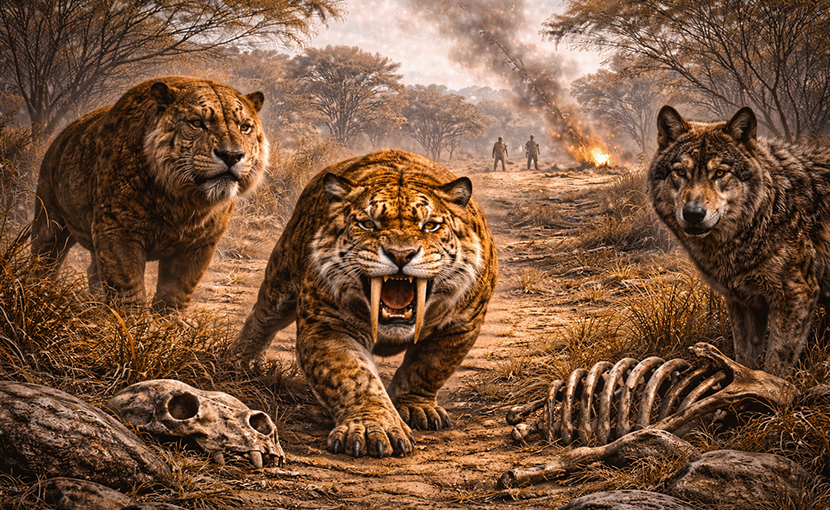
Saber-toothed cats, cave lions, giant wolves—
the Pleistocene world was inhabited by predators already perfected long before humans arrived.
Their persistence was not simply a matter of strength.
They survived because:
- prey species still existed,
- the food web had not fully collapsed,
- the ecosystem was still functioning.
Predators are not proof of health.
They are indicators of what remains.
Predators Are the Last to Disappear
When ecosystems collapse, the sequence is remarkably consistent:
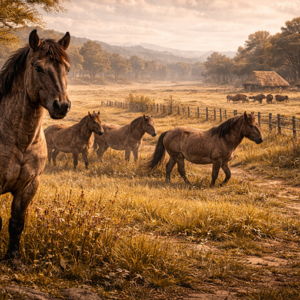
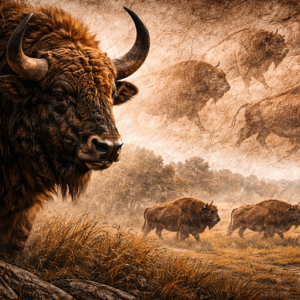
- Large herbivores decline
- Vegetation structure destabilizes
- Medium-sized species fluctuate or vanish
- Predators disappear last
Predator extinction is not the cause of collapse.
It is the final confirmation.
By the time apex predators vanish,
the system beneath them is already dead.
Humans Did Not Need to Hunt Predators
Paleolithic humans did not need to exterminate predators directly.
It was enough to:
- hunt large herbivores,
- alter landscapes with fire,
- control migration routes and water sources.
The predator’s world collapsed from below.
The saber-toothed tiger did not lose a battle against humans.
It was left standing in a world without prey.
Why Predators Could Not Adapt
Most Paleolithic predators were optimized for large prey.
- powerful forelimbs,
- ambush-based killing strategies,
- bodies designed for high-calorie returns.
These traits were not mistakes.
They were the correct solution for a stable world that lasted tens of thousands of years.
But when the assumptions of that world vanished,
perfection became vulnerability.
The Misconception of “Apex Survival”
The same misunderstanding persists today.
- Wolves still exist
- Lions remain
- Tigers have not vanished
Therefore, the ecosystem must be intact.
This assumption is false.
The presence of apex predators does not guarantee ecological health.
Predators persist into the final stages of collapse.
What the Paleolithic Left Us
The extinction of Paleolithic predators was not a byproduct of civilization.
It was the first moment when
humanity’s influence on entire ecosystems became visible.
Predators are like the mast of a sinking ship.
As long as it remains above water,
the collapse is easy to deny.
The survival of apex predators does not mean an ecosystem is alive.
More often,
their disappearance means it has already died.
The Paleolithic teaches us the order of collapse.
Destruction begins where we cannot easily see it.
Extinction-related book