Japanese | English
– A Life Erased as “Just Another Zebra” –
The Quagga
Once, on the grasslands of South Africa,
there lived an unusual kind of zebra.
It was the quagga.
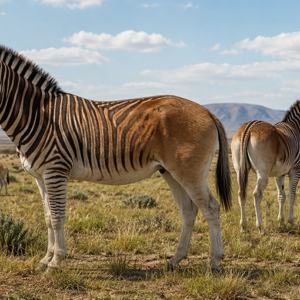
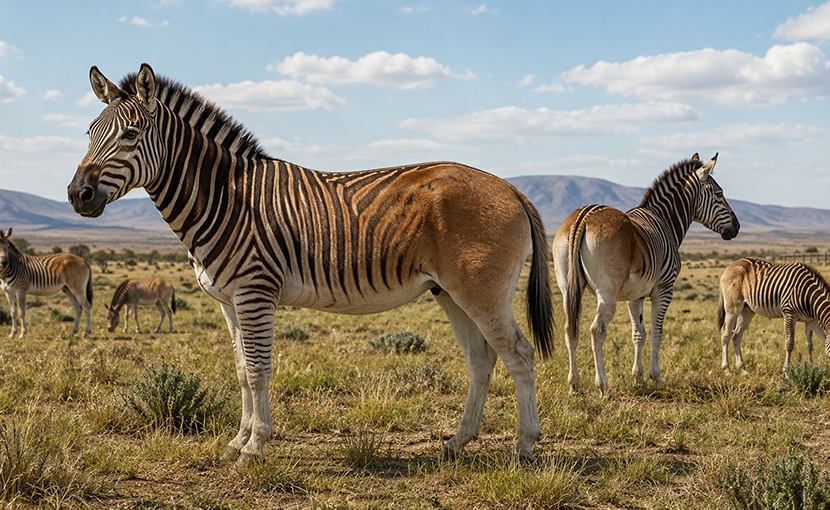
Its front half bore bold stripes.
But toward the rear of its body,
those stripes faded away,
giving it the appearance of a brown horse.
It looked different from the zebras we know today.
Yet to the people of the time,
the difference did not matter.
Basic Information
| Classification | Mammalia / Perissodactyla / Equidae |
|---|---|
| Scientific name | Equus quagga quagga |
| Time period | Holocene–1883 |
| Geographic range | South Africa |
| Body length | ~2.5 meters |
| Diet | Herbivorous |
| Distinctive traits | Strong striping on the front body, fading into brown coloration toward the rear |
The Truth Behind the “Half-Zebra”
For many years,
the quagga was believed to be
a separate species.
However, DNA analysis later revealed that it was actually
a subspecies of the plains zebra.
In other words,
what vanished was a unique evolutionary identity.
Collision with Ranching Economies
During the 19th century,
South Africa experienced:
- colonial expansion,
- rapid growth of livestock farming,
- increasing demand for grazing land.
Within this system, the quagga was seen as:
- competing with livestock for grass,
- easy to hunt,
- useful for meat and hides.
As a result,
it was hunted extensively.
“Unique” Was Not Yet Worth Protecting
Today, an animal with such a distinctive appearance
might have been protected immediately.
But at the time,
the quagga was viewed as nothing more than
a slightly unusual zebra.
When difference is not recognized,
protection rarely follows.
Value Recognized Too Late
By the late 19th century,
people finally began to realize
that quagga numbers were collapsing.
But it was already too late.
In 1883,
at the Artis Zoo,
the last captive quagga died.
Only afterward did society begin to understand:
its uniqueness had disappeared forever.
Why This Extinction Matters
The quagga was:
- not particularly dangerous,
- not responsible for major destruction,
- not eliminated during a food crisis.
And yet it vanished.
The reason was simple:
people believed there were substitutes.
The Extinction of Uniqueness
Extinction is not always the disappearance of an entire species.
Sometimes it is the loss of:
- regional populations,
- distinct genetic lineages,
- unique biological traits.
The quagga reminds us of the danger in assuming:
“similar” means “replaceable.”
The quagga did not disappear because it was weak.
Nor because it was exceptionally rare.
It vanished because
its difference was never understood.
Modernity became an age in which
life without visible value
could disappear quietly.
And humanity has often learned
the meaning of uniqueness only after it is gone.