Japanese | English
– The Predator Labeled an Enemy of Livestock –
The Tasmanian Tiger (Thylacine)
Once, on the island of Tasmania south of Australia,
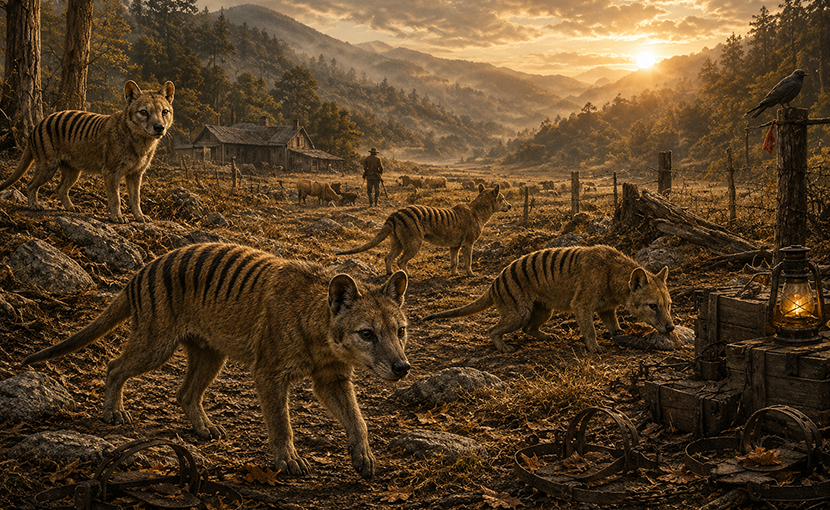
there lived a predator that looked like a wolf—
but was not a wolf.
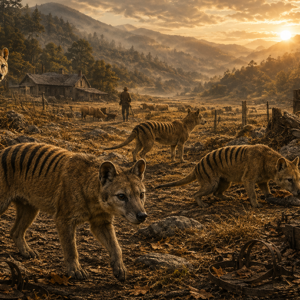
It was the Tasmanian tiger,
also known as the thylacine.
Named for the dark stripes across its back,
it was in fact a marsupial,
more closely related to kangaroos than to wolves.
For thousands of years,
it stood as Tasmania’s apex predator.
But modern society
no longer had room for it.
Basic Information
| Classification | Mammalia / Dasyuromorphia / Thylacinidae |
|---|---|
| Scientific name | Thylacinus cynocephalus |
| Time period | Holocene–1936 |
| Geographic range | Tasmania (historical period) |
| Body length | ~100–130 cm (excluding tail) |
| Diet | Carnivorous (small mammals, birds, etc.) |
| Distinctive traits | Dog-like body shape, striped back, marsupial predator |
An Isolated Apex Predator
The thylacine once inhabited mainland Australia as well.
However, due to:
- climate change,
- human arrival,
- competition with dingoes,
it disappeared from the mainland,
surviving only on the island of Tasmania.
The Age of Sheep
In the 19th century,
Tasmania experienced rapid growth in
the wool industry.
Within this economic transformation,
the thylacine came to be viewed as
an enemy of livestock.
The problem is that the true scale of livestock losses
was never fully clear.
Later studies suggest that
its threat may have been greatly exaggerated.
Bounty Hunting and Systematic Removal
Governments and private industries introduced:
- bounty programs,
- organized trapping,
- widespread use of snares.
The thylacine was treated as
an obstacle to economic productivity.
Fear alone did not drive extinction.
Here,
profit accelerated disappearance.
A Symbol of Modern Extinction
Other pressures emerged simultaneously:
- habitat destruction,
- disease,
- inbreeding due to shrinking populations.
Modern society rarely imposes one pressure at a time.
Instead,
multiple forces converge simultaneously,
removing the possibility of recovery.
The Last Individual
In 1936,
at the Beaumaris Zoo,
the last known captive thylacine—commonly known as Benjamin—died.
Wildlife protection laws had been introduced
only a few months earlier.
Protection came too late.
Why This Extinction Matters
The thylacine disappeared:
- not for food,
- not because it posed a major danger,
- but because of economic priorities.
This is a distinctly modern form of extinction.
The logic of profit
can outweigh the right to exist.
The “Unnecessary” Predator
Apex predators are often framed as:
- dangerous,
- inefficient,
- obstacles to productivity.
Yet removing them often destroys
the balance of ecosystems themselves.
The Tasmanian tiger did not disappear because it was weak.
Rather,
it had no reason to adapt to human economics.
A predator that once ruled an island
became economically inconvenient.
And modernity created a world in which
life judged unnecessary
could be erased systematically.