Japanese | English
– From Royal Symbol to an Unacceptable Presence –
The Lion (Disappearance from Europe and the Middle East)
Once, the lion was not an animal of Africa alone.
Across southern Europe, the Balkans,
and throughout the Middle East,
wild lions roamed the land.
They are not extinct as a species.
And yet,
they vanished completely from Europe and the Near East.
This was not a gradual fading by chance.
It was a deliberate removal by civilization.
Basic Information
| Classification | Mammalia / Carnivora / Felidae |
|---|---|
| Scientific name | Panthera leo |
| Time period | Late Pleistocene–Antiquity |
| Former range | Southern Europe, the Middle East, Indian subcontinent |
| Current range | Africa (and a small population in India) |
| Body mass | ~180–250 kg (males) |
| Diet | Carnivorous |
| Distinctive traits | Social apex predator, highly efficient hunter |
Lions in Europe and the Near East
From the Late Pleistocene into the early Holocene,
lions inhabited open grasslands and forest margins.
- Large herbivores were abundant
- Human and lion ranges overlapped
- Lions occupied the apex of the food web
The lions of Greek myth, Mesopotamian reliefs,
and ancient literature were not symbolic inventions—
they were real, living animals.
A Fatal Conflict with Humanity
As agriculture and permanent settlement expanded,
lions became direct competitors with humans.
They:
- preyed on livestock,
- occasionally killed people,
- could not be controlled or contained.
In a settled society,
a free-ranging apex predator was intolerable.
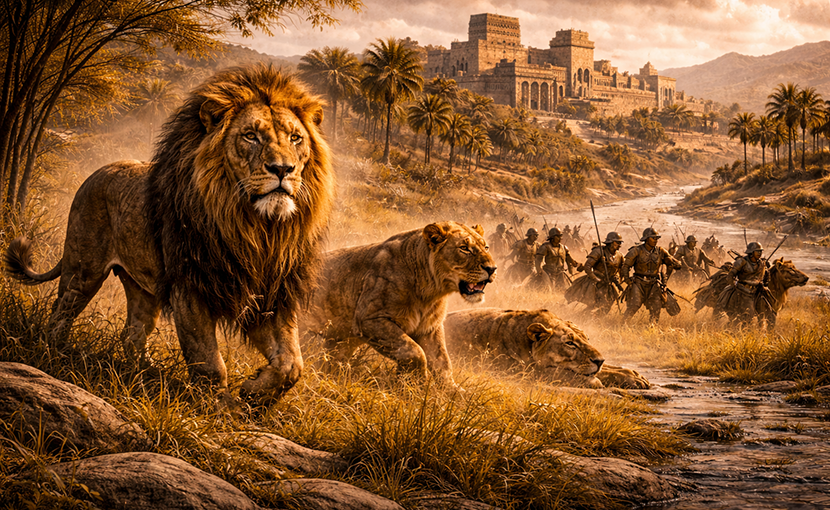
Kingship and the Lion Hunt
Paradoxically, the lion was both feared and revered.
- A symbol of royal authority
- A measure of courage and dominance
- The centerpiece of ritualized hunts
But beneath the symbolism lay reality:
organized eradication.
Why Lions Could Not Recover
Lions are vulnerable to sustained pressure:
- slow reproduction,
- need for extensive territories,
- sensitivity to persecution.
Combined with:
- habitat fragmentation,
- defensive killing to protect livestock,
- prestige hunting,
their populations collapsed.
Apex predators could not coexist with settled civilization.
Why Lions Survived in Africa
As with hippopotamuses, survival was not a matter of strength.
It depended on:
- vast remaining wild spaces,
- limits to human control,
- lower population density.
Where total domination of space was impossible,
lions endured.
What This Local Extinction Reveals
Lions were removed because they were:
- dangerous,
- uncontrollable,
- incompatible with human dominance.
Their disappearance marks
the moment civilization refused to tolerate another apex predator.
A Line That Extends to the Present
Today, lions are called “kings of Africa.”
But this title reflects survival, not origin.
The absence of lions from Europe and the Middle East
signals the point at which humans claimed the top position
in the ecological hierarchy.
The lion did not lose a natural contest.
It simply lost its place
in a world redesigned for human control.
When apex predators vanish,
the ecosystem has already been claimed.