Japanese | English
– A Species That Survived — A Landscape That Did Not –
The Hippopotamus (Local Extinction in the Mediterranean)
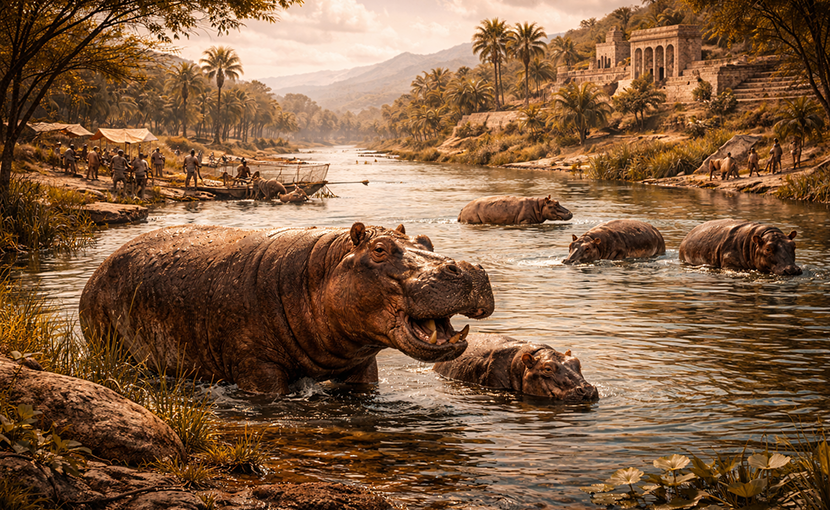
Once, the Mediterranean world held a scene that is difficult to imagine today.
Along rivers and wetlands,
wild hippopotamuses lived far beyond Africa.
They are not extinct as a species.
And yet,
they vanished completely from the Mediterranean world.
This was not a global extinction.
It was a civilizational removal.
Basic Information
| Classification | Mammalia / Artiodactyla / Hippopotamidae |
|---|---|
| Scientific name | Hippopotamus amphibius |
| Time period | Late Pleistocene–Antiquity |
| Former range | North Africa, the Levant, Mediterranean river systems |
| Current range | Sub-Saharan Africa |
| Body mass | ~1.5–3 metric tons |
| Diet | Herbivorous |
| Distinctive traits | Semi-aquatic lifestyle, extreme aggression, nocturnal grazing |
A Giant of Mediterranean Waters
From the Late Pleistocene into the early Holocene,
the Mediterranean region was far wetter than today.
It supported:
- permanent rivers,
- expansive wetlands,
- shared water margins between humans and animals.
Within these environments,
the hippopotamus was a keystone presence.
A Fatal Overlap with Humanity
The environments hippopotamuses depend on
are the same environments humans seek.
- water access,
- flat terrain,
- fertile floodplains.
In other words,
the birthplace of agricultural civilization.
This overlap sealed the hippopotamus’s fate.
A Dangerous Neighbor
The hippopotamus cannot be domesticated.
- It is highly territorial.
- It is among the most dangerous animals to humans.
- It poses constant risk to people, boats, and infrastructure.
In settled societies, this was unacceptable.
Hippopotamuses:
- trampled crops,
- damaged embankments and canals,
- threatened human lives.
They were judged incompatible with civilization.
Local Extinction as a Choice
What followed was not accidental.
- systematic culling,
- drainage and reclamation of wetlands,
- straightening and control of rivers.
Gradually, hippopotamuses disappeared
from Mediterranean rivers and coasts.
Ancient Egyptian and Levantine records
depict hippopotamus hunts as acts of order and control.
Why Hippos Remained in Africa
The reason is not simply biological.
It lies in space and control.
- larger remaining wild landscapes,
- lower population densities,
- limits to total river management.
In short,
places where humanity could not fully impose order still existed.
The hippopotamus is powerful.
But civilization reshapes space itself.
What This Local Extinction Reveals
This was not a case of wild animals being “useless.”
It was a case of wild animals being too dangerous to tolerate.
- not food,
- not livestock,
- not manageable.
Their mere presence conflicted with the logic of settled life.
A Line That Reaches the Present
Today, hippopotamuses are thought of as African animals.
But this is only a remnant of their former range.
Their disappearance from the Mediterranean marks
the moment humans fully claimed control over water and floodplains.
The hippopotamus did not vanish.
But it was expelled from the human world.
That expulsion marks a boundary—
the point at which civilization decided
what kinds of wildness it would no longer allow.
The rivers of the Mediterranean, now silent of hippos,
ask a lingering question:
How much wildness can coexist with order?