

Japanese | English
– An Ethical Analysis of Welfare, Cognition, and Economic Structures –
Abstract
This paper critically examines the practice of training and exhibiting highly intelligent marine animals—particularly dolphins and orcas—for entertainment purposes. Drawing from animal welfare science, cognitive ethology, moral philosophy, and political economy, it argues that such practices entail significant psychological and physiological harm. These species naturally inhabit complex social systems and traverse vast marine territories; confinement in artificial environments disrupts their social structures, restricts natural behaviors, and generates chronic stress. The continued existence of marine performance industries is sustained not by ethical justification but by economic incentives and social normalization. This paper analyzes five dimensions: (1) cognitive sophistication and moral status, (2) social deprivation, (3) physical health impacts, (4) audience psychology, and (5) economic structures. It concludes that the entertainment-based captivity of highly intelligent marine mammals warrants fundamental ethical reconsideration.
1. Introduction
Among marine mammals, the Bottlenose Dolphin (Bottlenose Dolphin) and the Orca (Orca) are widely recognized for their advanced cognitive capacities. Empirical research demonstrates complex communication systems, social learning, problem-solving ability, and evidence of self-recognition.
Despite these findings, such animals are routinely confined in marine parks and trained to perform choreographed behaviors for human audiences. This raises a central ethical question: can the instrumentalization of cognitively complex, socially embedded beings for entertainment be morally justified?
2. Cognitive Sophistication and Moral Considerability
2.1 Self-Recognition and Social Intelligence
Dolphins have passed mirror self-recognition tests—an ability observed in only a small number of non-human species. They also employ individualized signature whistles functioning analogously to names.
In moral philosophy, the possession of sentience, self-awareness, and social attachment strengthens claims to moral considerability. If an organism can experience psychological suffering and maintain enduring social bonds, its reduction to a performative commodity becomes ethically problematic.
The moral issue, therefore, is not merely biological captivity, but the confinement of a cognitively and emotionally complex subject.
3. Social Structure Disruption and Psychological Harm
3.1 Natural Social Organization
In the wild, orcas form stable matrilineal societies, sometimes spanning multiple generations. Dolphins likewise maintain intricate and dynamic social networks.
3.2 Captive Social Reconfiguration
Marine parks frequently transfer individuals between facilities for breeding or management purposes. Such restructuring dismantles natural social bonds and may induce:
- Chronic stress responses
- Heightened aggression
- Lethargy or depressive-like states
- Stereotypic behaviors (repetitive, non-functional movements)
For highly social species, prolonged social instability may produce neuroendocrine effects comparable to long-term isolation stress in humans.
4. Spatial Restriction and Physiological Consequences
4.1 Range Compression
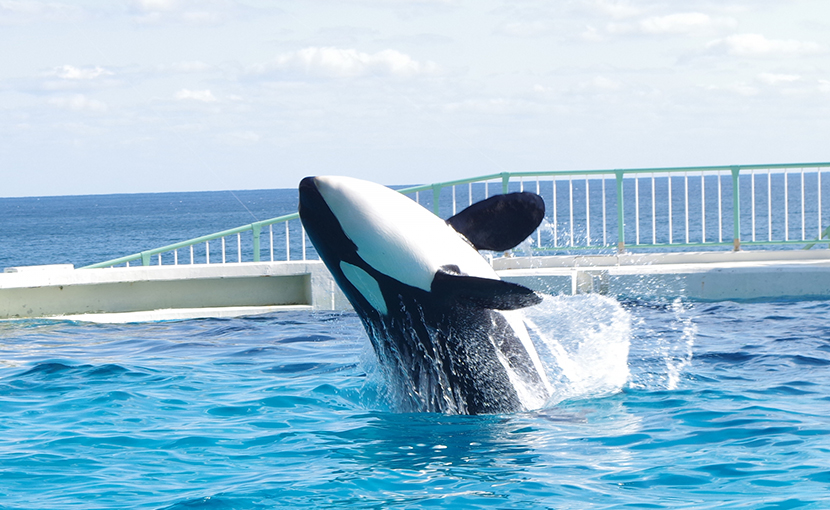
Wild orcas may travel over 100 kilometers per day. Captive environments reduce this range to a confined tank.
4.2 Health Complications
Observed issues in captive orcas include:
- Dorsal fin collapse
- Dental damage from stress-related behaviors
- Increased susceptibility to infection
These conditions are not incidental; they emerge from the interaction between environmental deprivation and physiological stress. The body becomes the site where psychological confinement manifests materially.
5. Audience Psychology and Ethical Disengagement
The persistence of marine animal shows depends not only on institutions but also on public demand.
5.1 Mechanisms of Justification
Audiences often rationalize participation through:
- Framing shows as educational
- Assuming animals “enjoy” performing
- Treating captivity as culturally normalized entertainment
Cognitive dissonance theory suggests that when confronted with the tension between enjoyment and potential cruelty, individuals tend to minimize perceived harm rather than relinquish the pleasurable activity. This psychological disengagement diffuses moral responsibility.
6. Economic Incentives and Institutional Continuity
Marine entertainment facilities operate within robust commercial ecosystems involving ticket revenue, tourism flows, merchandising, and regional employment.
The structural drivers include:
- Capital recovery requirements
- Local economic dependence
- Regulatory permissiveness
- Brand identity investments
Profit functions as a stabilizing force, often overriding ethical objections. Thus, the issue is systemic rather than incidental.
7. Viable Alternatives
Technological and conservation-oriented alternatives challenge the claim that performance captivity is necessary:
- Coastal sanctuaries for retired marine mammals
- Virtual and augmented reality marine education
- Ethical whale- and dolphin-watching ecotourism
These alternatives demonstrate that public engagement and education need not depend on coercive confinement.
8. Conclusion
The training and exhibition of highly intelligent marine mammals for entertainment involves profound ethical tensions. The evidence indicates:
- Disruption of natural social systems
- Psychological stress and behavioral pathology
- Physiological deterioration
- Public moral disengagement
- Economic structures reinforcing the practice
When examined through the frameworks of animal welfare science and moral philosophy, entertainment-based captivity appears increasingly indefensible.
The debate, therefore, is not merely about animal rights sentiment but about how societies integrate scientific knowledge of cognition and suffering into institutional practice. A transition toward non-exploitative forms of marine engagement represents not only an ethical imperative but an epistemically informed evolution of human responsibility.









コメント