Japanese | English
– Ivory Desired by Kings and Empires –
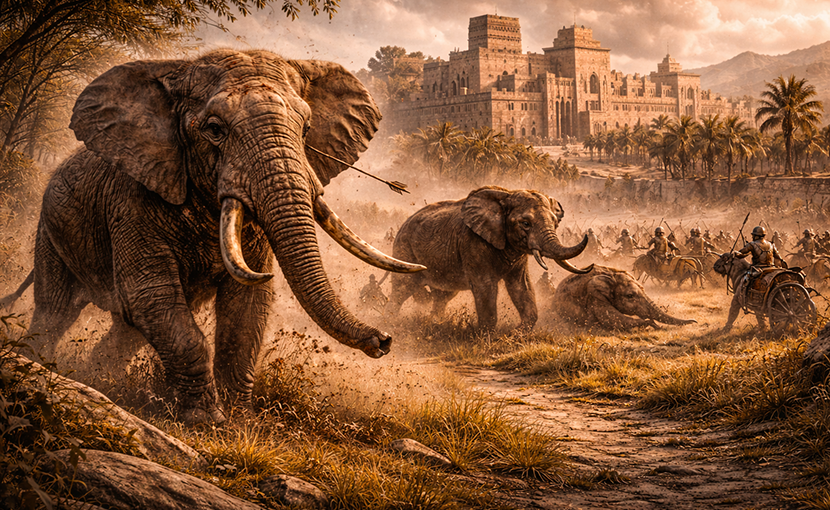
The Syrian Elephant (Elephas maximus asurus)
Once, in the ancient Near East,
there lived an elephant whose fate became entwined with war, ritual, and power.
This was the Syrian elephant (Elephas maximus asurus)—
a regional form closely related to the Asian elephant, believed to have inhabited Mesopotamia, Syria, and the Levant.
Its disappearance was not the result of chance,
nor merely of agricultural expansion.
It was hunted to extinction by civilization itself.
Basic Information
| Classification | Mammalia / Proboscidea / Elephantidae |
|---|---|
| Scientific name | Elephas maximus asurus (commonly used designation) |
| Time period | Late Pleistocene–1st millennium BCE |
| Geographic range | Syria, Mesopotamia, the Levant |
| Shoulder height | Over ~3 meters |
| Body mass | ~4–5 metric tons |
| Diet | Herbivorous |
| Distinctive traits | Massive body, prominent tusks, adaptation to semi-arid environments |
Ruler of the Land Before Civilization
Before the rise of states, the Syrian elephant occupied river valleys, wetlands, and forest margins.
- It had virtually no natural predators.
- Its size shaped vegetation and water access.
- It stood as one of the largest land animals in the region.
In ecological terms,
it was a keystone megaherbivore.
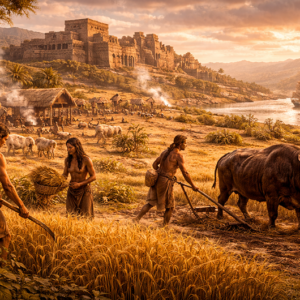
A Shift in Human Meaning
To early humans, elephants inspired fear and reverence.
With the emergence of city-states and empires, that meaning changed:
- Ivory became a symbol of authority.
- Elephant hunts became displays of royal power.
- Tusks entered military, ceremonial, and trade networks.
The elephant transformed into a managed resource of the state.
Hunting as State Policy
The destruction of the Syrian elephant was not driven by isolated hunters.
It involved:
- organized royal expeditions,
- armed groups acting under command,
- records carved into stone and palace reliefs.
Assyrian artworks proudly depict elephant hunts—
visual proof that this extinction was intentional and celebrated.
Why Recovery Was Impossible
Elephants possess traits that make them exceptionally vulnerable to sustained pressure:
- extremely slow reproduction,
- dependence on intact habitats,
- complex social structures that collapse under disturbance.
Combined with:
- agricultural expansion,
- control of river systems,
- continuous, organized hunting,
the population could not recover.
State-level pressure overwhelmed biological resilience.
What the Syrian Elephant’s Extinction Reveals
This extinction differs fundamentally from Paleolithic losses.
Here we see:
- intent,
- documentation,
- power aligned with eradication.
Humanity had crossed another threshold—
from hunting to survive
to choosing which species would disappear.
The Life Behind the Ivory
Ivory endured.
Cities and empires endured.
The elephant did not.
This marks one of the earliest cases in which
civilization fully consumed a giant species—
and moved on.
The Syrian elephant did not lose to nature.
It was caught in the success of civilization.
Its absence reminds us that
development does not imply coexistence.
Sometimes, it means erasure.