Japanese | English
– The Wild That Refused to Be Tamed –
The Tarpan (Wild Horse)
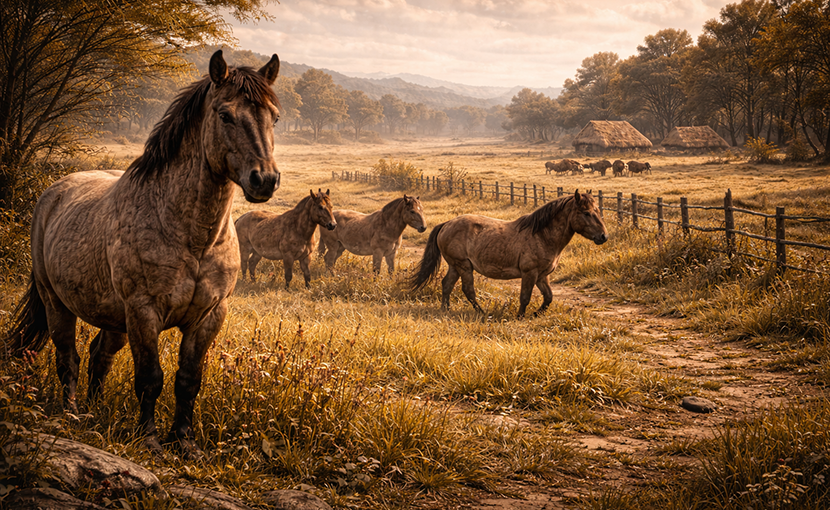
Once, across the grasslands and forest margins of Eurasia,
small but resilient wild horses moved in tightly bonded herds.
They were known as the tarpan—
a wild horse closely related to the ancestors of modern domestic horses,
yet one that never fully submitted to human control.
The tarpan did not fail to become livestock.
It was a form of wildness that resisted domestication.
Basic Information
| Classification | Mammalia / Perissodactyla / Equidae |
|---|---|
| Scientific name | Equus ferus ferus (commonly used designation) |
| Time period | Late Pleistocene–19th century |
| Geographic range | Eastern Europe to Central Asia |
| Shoulder height | ~130–140 cm |
| Body mass | ~300 kg |
| Diet | Herbivorous |
| Distinctive traits | Short upright mane, dark coat, extreme wariness toward humans |
A Fully Realized Wild Horse
The tarpan was finely adapted to harsh steppe environments.
It possessed:
- the ability to survive on sparse forage,
- strong herd cohesion,
- acute awareness of predators and humans alike.
These traits ensured survival in the wild—
but made the tarpan unsuitable for human use.
The Divide Between Wild and Domestic Horses
Humans did not domesticate all horses.
They selected individuals that were:
- docile,
- manageable,
- suitable for controlled breeding.
From these lineages emerged domestic horses.
The tarpan was excluded from this process—
not by chance, but by temperament.
From Resource to Enemy
From Resource to Enemy
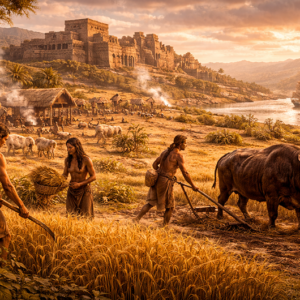
With the spread of agriculture and permanent settlement,
the tarpan’s status shifted.
It became:
- a destroyer of crops,
- a competitor for pasture,
- an animal that could not be controlled.
In Neolithic and later societies,
the tarpan was increasingly treated as a pest.
The Path to Extinction
The tarpan’s extinction was gradual rather than sudden.
Key pressures included:
- expansion of farmland,
- enclosure of grazing lands,
- interbreeding with domestic horses,
- sustained persecution and culling.
Over generations, pure wild populations disappeared.
The last tarpan is believed to have vanished in the 19th century.
Why It Cannot Truly Be Restored
Today, some horses are claimed to be “recreated tarpans.”
But these animals are reconstructions based on appearance alone.
They do not represent the lost wild form.
Wildness is not just genetic.
It is behavioral, ecological, and historical.
That totality is gone.
What the Tarpan’s Extinction Reveals
The tarpan did not disappear because it was weak.
It disappeared because it did not adapt to human society.
This marks a defining feature of Neolithic-era extinctions:
not random loss,
but the systematic removal of wildness that resisted control.
The tarpan ran until the end.
It was never fully absorbed into the human world.
It lived as a wild animal—
and vanished as one.
In its absence,
we glimpse the outline of something humanity chose not to keep.