Japanese | English
– Survived — but Lost Its World –
The Ancestral European Bison
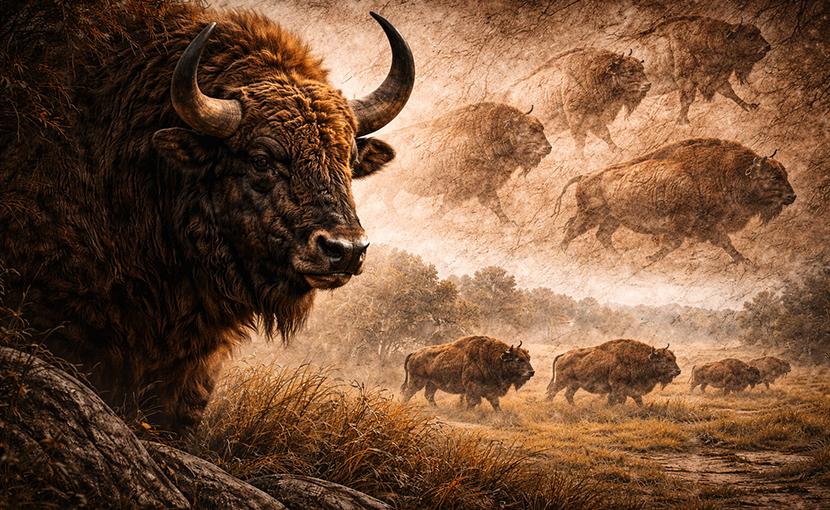
Once, along the grasslands and forest edges of Europe,
vast herds of powerful wild bison moved across the land.
These were the ancestral European bison—
primitive lineages leading to the modern European bison (wisent),
larger, wilder, and inseparable from open landscapes.
They did not vanish completely.
But the ecosystem that sustained them did.
Basic Information
| Classification | Mammalia / Artiodactyla / Bovidae |
|---|---|
| Lineage | Primitive bison (including the steppe bison complex) |
| Time period | Late Pleistocene–Early Holocene |
| Geographic range | Europe to Western Asia |
| Shoulder height | Often exceeding 200 cm |
| Body mass | Over 1 metric ton |
| Diet | Herbivorous |
| Distinctive traits | Massive shoulder hump, thick coat, strong herd cohesion |
Architects of the Open Landscape
The ancestral European bison was more than a grazer.
By:
- trampling vegetation,
- suppressing forest expansion,
- maintaining grassland mosaics,
it functioned as a landscape engineer.
Together with the aurochs,
these bison helped sustain the open environments of prehistoric Europe.
A Long Relationship with Humans
In the Paleolithic,
bison were among humanity’s most important prey.
They appear repeatedly in cave paintings—
objects of fear, reverence, and dependence.
But with the Neolithic transition,
as humans adopted agriculture and permanent settlements,
the relationship changed.
Bison increasingly became:
- competitors for land,
- obstacles to farming,
- animals too large to tolerate.
They shifted from necessity to inconvenience.
Habitat Loss as the Fatal Blow
The decisive factor in the disappearance of ancestral bison
was not overhunting alone.
It was:
- conversion of grasslands into farmland,
- enclosure and management of forests,
- disruption of long-distance migration routes.
The space required for survival disappeared.
Large, mobile animals suffered first.
Survival as Separation
Eventually, European bison survived only in
small, isolated forest refuges.
These remnant populations gave rise to the modern wisent.
But this was not true survival of the ancestral form.
It was a severing from the original ecosystem—
a reduced existence, detached from the open landscapes that once defined the species.
Why the Ancestral Form Vanished
The ancestral European bison required:
- expansive open terrain,
- seasonal movement,
- freedom from intensive human management.
These traits were not weaknesses.
They were hallmarks of a functioning wild system.
But in a world reshaped for agriculture,
such wildness had no place.
The Crucial Difference from the Aurochs
- Aurochs
→ domesticated; the wild form erased - Ancestral European bison
→ not domesticated; its ecosystem erased
Both outcomes reflect deliberate human choices.
The Neolithic Lesson
The disappearance of ancestral bison was not due to neglect.
It occurred because
when an ecosystem becomes unnecessary,
the species that depend on it follow.
By the Neolithic age,
humans had already become designers of the world.
The European bison survived.
But its world did not.
This is a loss distinct from extinction—
a quiet erasure of context, function, and freedom.