Japanese | English
– When the Hunter Lost Its Prey –
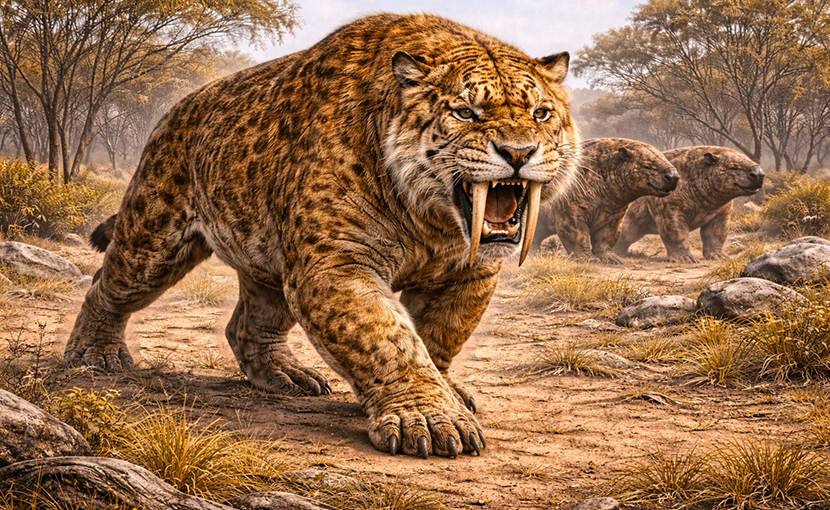
The Saber-Toothed Tiger (Smilodon)
Once, during the Pleistocene,
a predator bearing impossibly long fangs ruled the land.
This was the saber-toothed tiger,Smilodon.
Among the most formidable hunters of its time, its extinction was paradoxically quiet.
Smilodon was not exterminated directly by humans.
Yet with humanity’s arrival, its world steadily disappeared.
Basic Information
| Classification | Mammalia / Carnivora / Felidae (Machairodontinae) |
|---|---|
| Time period | Pleistocene (approx. 2.5 million–10,000 years ago) |
| Geographic range | North and South America |
| Body length | ~2.2 meters |
| Body mass | ~160–300 kg |
| Diet | Carnivorous |
| Distinctive traits | Saber-like canines up to ~20 cm; extremely powerful forelimbs |
Smilodon as a Predator
Smilodon was not a pursuit hunter.
Instead, it relied on:
- ambush rather than speed,
- overpowering prey with massive forelimbs,
- delivering a precise, lethal bite to the throat.
This strategy was extraordinarily effective
in a world rich with large, slow-moving herbivores.
A World It Depended On
Smilodon’s prey base included:
- juvenile mammoths,
- bison,
- giant ground sloths,
- large marsupial herbivores comparable to Nototherium and Diprotodon.
In other words,
the very megafauna that humans eliminated first.
As a top predator, Smilodon stood upon this vast herbivore network.
The Path to Extinction
Between roughly 12,000 and 10,000 years ago,
large herbivores vanished rapidly across the Americas.
Almost in parallel, Smilodon disappears from the fossil record.
Key observations include:
- close temporal overlap with human expansion,
- extinction patterns unexplained by climate change alone,
- selective loss of specialized large-prey predators.
When the prey vanished, the predator followed.
Why Adaptation Failed
Smilodon was poorly suited to hunting small, fast prey.
- Its canines were powerful yet fragile.
- Its hunting style required large-bodied animals.
- Its anatomy assumed high-calorie returns per kill.
Humans:
- removed megaherbivores,
- fragmented habitats,
- transformed hunting grounds.
As a result,
Smilodon’s entire hunting strategy collapsed.
What Smilodon’s Extinction Reveals
Smilodon was not weak.
It was an apex predator refined by millions of years of evolution.
But specialization has limits.
When the foundation of an ecosystem is removed,
even the most efficient hunters cannot survive.
Humanity did not need to hunt Smilodon directly.
By erasing its prey, humans erased the predator.
The Question That Remains
Smilodon did not lose a battle with humans.
It lost its world.
In that sense, its extinction marks a turning point—
the moment humans began reshaping ecosystems at every level,
from prey to predator.
Extinction-related book