Japanese | English
– When Being the Largest Became the Final Reason –
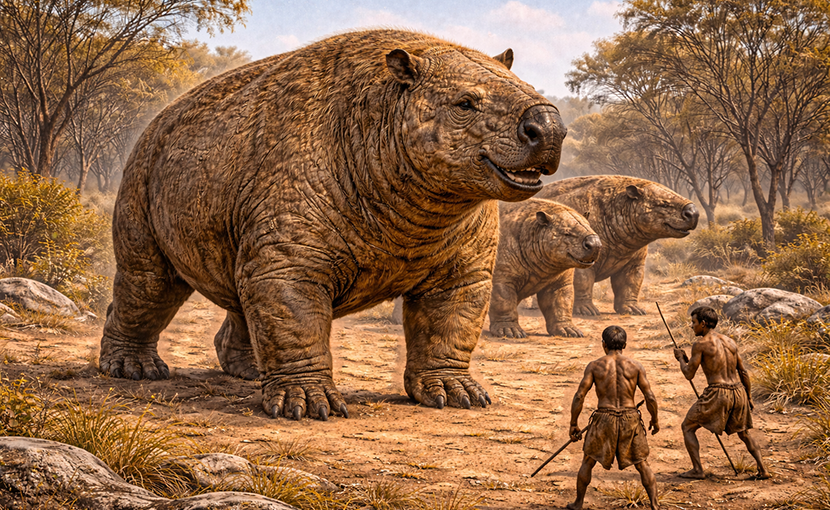
Diprotodon
Once, on the Australian continent,
there lived the largest marsupial ever to walk the Earth.
Its name was Diprotodon.
Reaching over four meters in length and weighing an estimated two to three metric tons,
it dwarfed every living marsupial species known today.
For a long time, this immense size placed Diprotodon at the center of its ecosystem.
And in the end,
that same size made it impossible to ignore.
Basic Information
| Classification | Marsupial (Diprotodontia / Diprotodontidae) |
|---|---|
| Time period | Pleistocene (approx. 2 million–40,000 years ago) |
| Geographic range | Australia |
| Body length | Up to ~4 meters |
| Estimated weight | 2–3 metric tons |
| Diet | Herbivorous |
| Distinctive traits | Enormous body mass, powerful jaws, low center of gravity |
What It Meant to Be the Largest
Within Australia’s ecosystems, Diprotodon held an overwhelming size advantage.
- It had virtually no natural predators.
- It may have moved in groups.
- It consumed vast quantities of vegetation efficiently.
Before humans arrived, this strategy worked almost perfectly.
To be large was to be protected.
To be large was to dominate.
The Path to Extinction
Diprotodon vanished rapidly around 40,000 years ago, alongside Nototherium and other Australian megafauna.
This timing closely coincides with
the permanent establishment of modern humans on the continent.
Evidence includes:
- a sharp decline in fossil records,
- temporal overlap with human archaeological sites,
- signs of widespread landscape modification through fire.
Taken together, these patterns suggest that climate change alone cannot account for Diprotodon’s disappearance.
Why Size Became a Liability
Diprotodon possessed traits that once ensured success:
- slow reproduction,
- wide-ranging movement,
- extremely high resource demands.
Humans introduced new pressures:
- coordinated hunting,
- strategic use of fire,
- knowledge of migration routes and water sources.
In this new context,
the loss of even a few large individuals could not be recovered.
What had once been strength became fragility.
What Diprotodon’s Extinction Reveals
Diprotodon was not an evolutionary failure.
It represented the extreme refinement of gigantism as a survival strategy.
Yet it could not withstand a species capable of reshaping ecosystems themselves.
Its extinction marks a moment when scale alone ceased to guarantee survival.
Where the Giant’s Path Ended
Diprotodon did not collapse in a dramatic confrontation.
It was not chased into oblivion.
Instead,
the world it required to live quietly disappeared.
In this new world,
being the largest was no longer protection—
it was exposure.
Extinction-related book