Japanese | English
– The First Mass Extinction: Was Humanity Ever a Coexisting Species? –
Around 70,000 years ago,
modern humans—Homo sapiens—left Africa.
Within only a few tens of thousands of years, they spread across Eurasia, Oceania, and eventually the Americas.
In the context of Earth’s history, this expansion was astonishingly rapid.
And strikingly, their footsteps align with another global pattern:
the disappearance of large animals across multiple continents.
This phenomenon is now widely regarded as
the first mass extinction caused by humanity.
Was This Truly a “Natural” Extinction?
Was This Truly a “Natural” Extinction?
For much of the twentieth century, these extinctions were attributed primarily to climate change at the end of the Ice Age.
Certainly, the environment was shifting.
Cold grasslands contracted, while forests and wetlands expanded.
However, advances in paleoecology, archaeology, and radiocarbon dating have revealed a more troubling pattern:
- Megafaunal extinctions occurred soon after human arrival on each continent
- The speed of disappearance exceeds what climate change alone can explain
- Fossils frequently show cut marks and butchery traces made by stone tools
Together, these lines of evidence strongly suggest that human presence was a decisive factor.
Paleolithic Humans as a Novel Predator
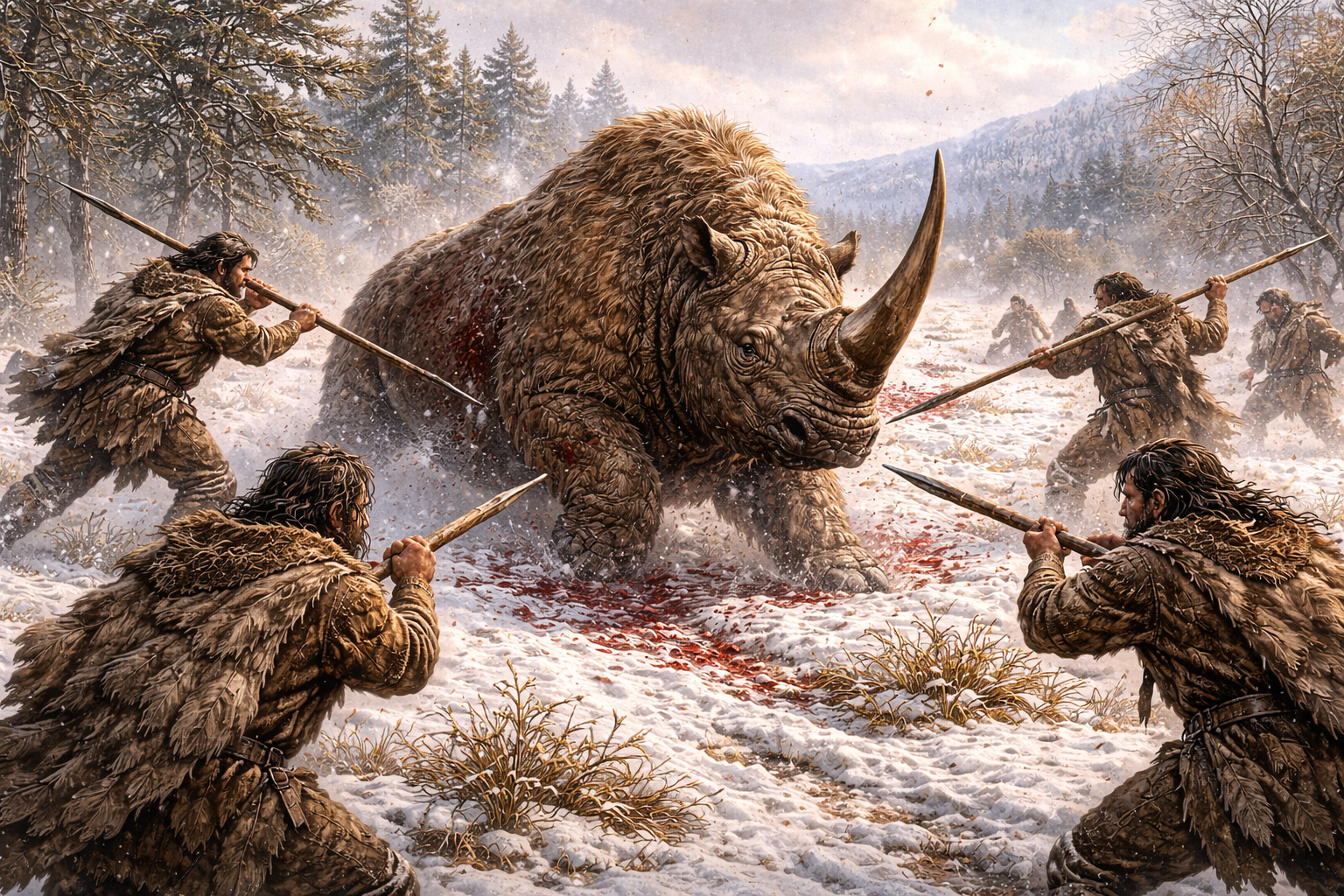
Paleolithic humans were few in number and technologically simple by modern standards.
Yet ecologically, they were something entirely new.
They hunted using:
- weapons rather than teeth or claws,
- coordinated group strategies,
- anticipation of animal behavior,
- planning across seasons.
This represented a qualitatively different form of predation—
one ecosystems had never encountered before.
Even small populations could exert enormous pressure.
Why Large Animals Vanished First
The first species to disappear shared key traits:
- large body size,
- slow reproductive rates,
- long maturation periods,
- no evolutionary experience of humans as predators.
Mammoths, woolly rhinoceroses, giant ground sloths, glyptodons, and the Irish elk all fit this profile.
Even limited hunting pressure was enough to cause irreversible population collapse.
Extinction Was Not Intentional
It is crucial to note that Paleolithic humans did not set out to exterminate species.
They hunted to survive.
They used available resources efficiently.
They moved, adapted, and raised their children.
Yet the outcome was unmistakable.
Humanity became, for the first time,
a force capable of reshaping entire ecosystems.
Coexistence or Disruption?
So—was humanity a coexisting species?
The answer is not simple.
Paleolithic humans did not seek domination over nature.
But they also lacked awareness of ecological limits.
Coexistence does not require intent to fail.
Sometimes, it fails simply because limits are unknown.
By the Paleolithic Age, humans had already crossed a threshold:
they were no longer merely part of nature.
What the First Mass Extinction Reveals
The Paleolithic mass extinction was not a byproduct of modern industry.
It was the first moment when
the defining traits of our species became ecologically visible:
- intelligence
- technology
- social cooperation
- foresight
These strengths were also sources of unprecedented destructive power.
What We Have Inherited
Today’s biodiversity crisis—the so-called sixth mass extinction—
is not a new phenomenon.
It is an acceleration of a process that began in the Paleolithic.
The difference lies in scale, speed, and awareness.
This time, we know.
We know our actions alter ecosystems.
And still, we choose.
The first mass extinction was never declared.
It left no written record.
Life simply diminished,
and the world quietly changed.
At the center of that change stood humanity.
To learn this history is not to assign guilt.
It is to make possible, for the first time,
a conscious choice of coexistence.
Extinction-related book