Japanese | English
– When Enormous Antlers Sealed a Fate –
The Irish Elk (Megaloceros giganteus)
Once, along the grasslands and forest edges of Eurasia,
there walked a deer bearing antlers of almost unimaginable size.
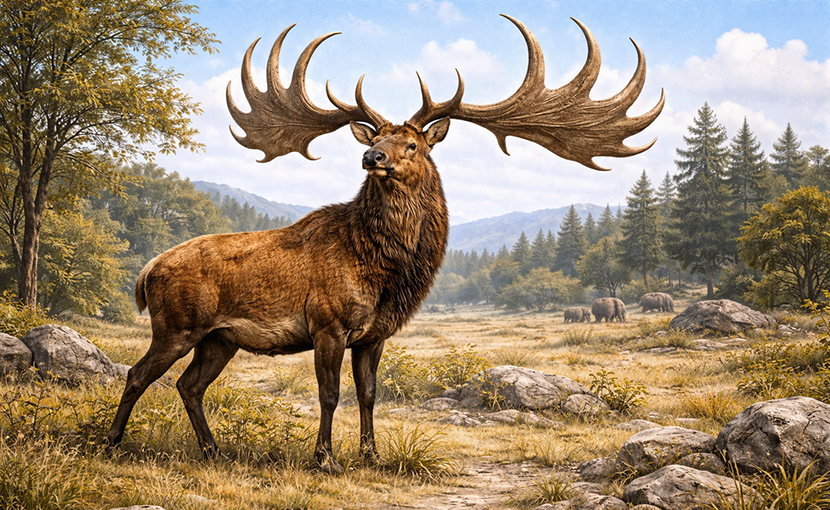
This was the Irish elk (Megaloceros giganteus)
Its antlers could span more than 3.5 meters, making them the largest ornamental structures ever carried by a land mammal.
They were a symbol of dominance and splendor—
and ultimately, a burden that shaped its fate.
Basic Information
| Order / Family | Artiodactyla / Cervidae |
|---|---|
| Time period | Late Pleistocene (approx. 400,000–7,700 years ago) |
| Geographic range | Europe to western Asia |
| Shoulder height | Up to ~2 meters |
| Body mass | 600–700 kg |
| Distinctive feature | Extremely large antlers (males only) |
The Meaning of Enormous Antlers
The antlers of the Irish elk were not primarily weapons against predators.
Their main functions were:
- displays during the breeding season,
- competition among males,
- visual signals to attract females.
They were the result of extreme sexual selection—
a biological investment in beauty and display rather than survival.
In open, nutrient-rich landscapes, such antlers were a clear advantage.
They signaled strength, health, and genetic fitness.
Environmental Change Turns Advantage into Burden
Toward the end of the Pleistocene, climates shifted.
Open grasslands gradually gave way to expanding forests.
For the Irish elk, this transition proved disastrous:
- antlers snagged on trees and undergrowth,
- mobility declined,
- the nutritional cost of growing and maintaining antlers became unsustainable.
An adaptation once favored by evolution became a liability almost overnight.
The Path to Extinction
For many years, the Irish elk’s extinction was attributed solely to climate-driven habitat change.
Today, however, a different picture has emerged:
- the timing of extinction closely aligns with human expansion,
- fossil distributions suggest hunting pressure,
- males with large antlers may have been selectively targeted.
The most plausible explanation is a combined effect:
populations weakened by environmental change were pushed beyond recovery by human hunting.
Why Antlers Determined Its Fate
The Irish elk possessed traits that made it especially vulnerable:
- limited maneuverability,
- high visibility,
- antlers that held material and symbolic value for humans.
To Paleolithic hunters, these antlers were:
- conspicuous targets,
- valuable resources for tools or ornaments.
A trait shaped by sexual selection became fatal under human selection.
What the Irish Elk’s Extinction Reveals
The Irish elk did not disappear because it was poorly adapted.
On the contrary, it was the product of exceptionally successful evolution.
But evolution does not anticipate new rules.
When an intelligent, strategic predator entered the ecosystem,
even the most refined adaptations could collapse.
A Question Cast in Antlered Shadow
Those vast antlers once defined the Irish elk’s presence in the world.
In the end, they made that presence impossible to ignore.
Beauty does not guarantee survival.
That quiet truth remains one of humanity’s earliest lessons,
etched into the deep history of life on Earth.
Extinction-related book