Japanese | English
– The Giant That Knew No Fear –
Megatherium
Once, across the vast landscapes of the Americas,
there walked a colossal herbivore—slow, massive, and seemingly invincible.
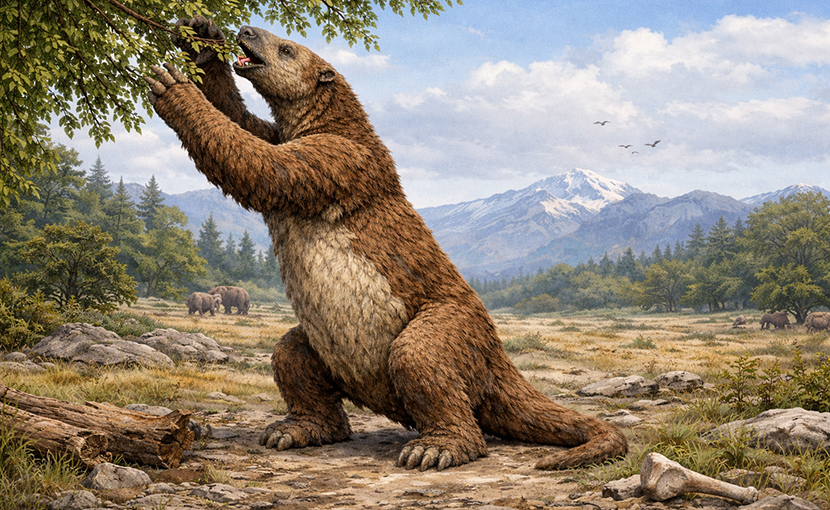
This was Megatherium, the giant ground sloth.
Its name means “great beast,” and it lived up to it.
At over six meters in length and weighing as much as four tons, Megatherium was among the largest land mammals ever to exist.
And yet, despite its size, it lived without fear.
Not because it was fearless—
but because it had never encountered anything it needed to fear.
Basic Information
| Scientific name | Megatherium americanum (and related species) |
|---|---|
| Classification | Ground sloths (Mammalia) |
| Time period | Late Miocene to Late Pleistocene (approx. 4 million–10,000 years ago) |
| Distribution | North and South America (primarily South America) |
| Size | 4–6 m in length; 2–4 metric tons |
| Diet | Herbivorous (leaves, branches, fruits) |
The Meaning of Gigantism
Megatherium followed an evolutionary strategy that appears paradoxical:
enormous size combined with slow movement.
In ecosystems dominated by fast, coordinated predators, such a strategy would be fatal.
But for most of its evolutionary history, Megatherium had no natural enemies capable of hunting it.
There were no bipedal predators, no weapon users, no coordinated hunters.
Gigantism was not a liability—it was protection.
As a result, Megatherium evolved toward size and strength rather than speed or vigilance.
The Path to Extinction
For millions of years, Megatherium thrived across the Americas.
Then, around 10,000 years ago, modern humans arrived.
Soon after, Megatherium populations declined rapidly.
Archaeological sites reveal:
- bones bearing stone-tool cut marks,
- skeletal distributions consistent with human hunting and butchery.
These findings strongly suggest that human predation played a decisive role in the species’ extinction.
Why Humans Were Decisive
The predator Megatherium encountered was unlike any before.
Humans hunted using:
- spears and projectile weapons,
- coordinated group tactics,
- planning and anticipation.
Against such methods, size offered little protection.
Megatherium’s slow movement, lack of evasive behavior, and absence of fear responses—once advantages—became fatal weaknesses.
Evolution had not prepared it for this encounter.
What Megatherium’s Extinction Reveals
Megatherium was not poorly adapted.
It was the product of a long and successful evolutionary history in a stable ecosystem.
But evolution cannot anticipate the sudden appearance of an entirely new kind of predator.
Its extinction demonstrates a fundamental ecological truth:
the arrival of a novel predator can destabilize even the most resilient systems.
Megatherium did not fail.
The rules of the game changed.
The giant ground sloth did not vanish in a single catastrophic moment.
Its disappearance was gradual, regional, and irreversible.
Megatherium did not know fear—
because it had never needed to.
That ignorance was not a flaw.
It was the natural consequence of a world that had never known humanity.
And in that silence lies one of the earliest lessons of human history.
Extinction-related book