Japanese | English
– A Giant of the Ice Age –
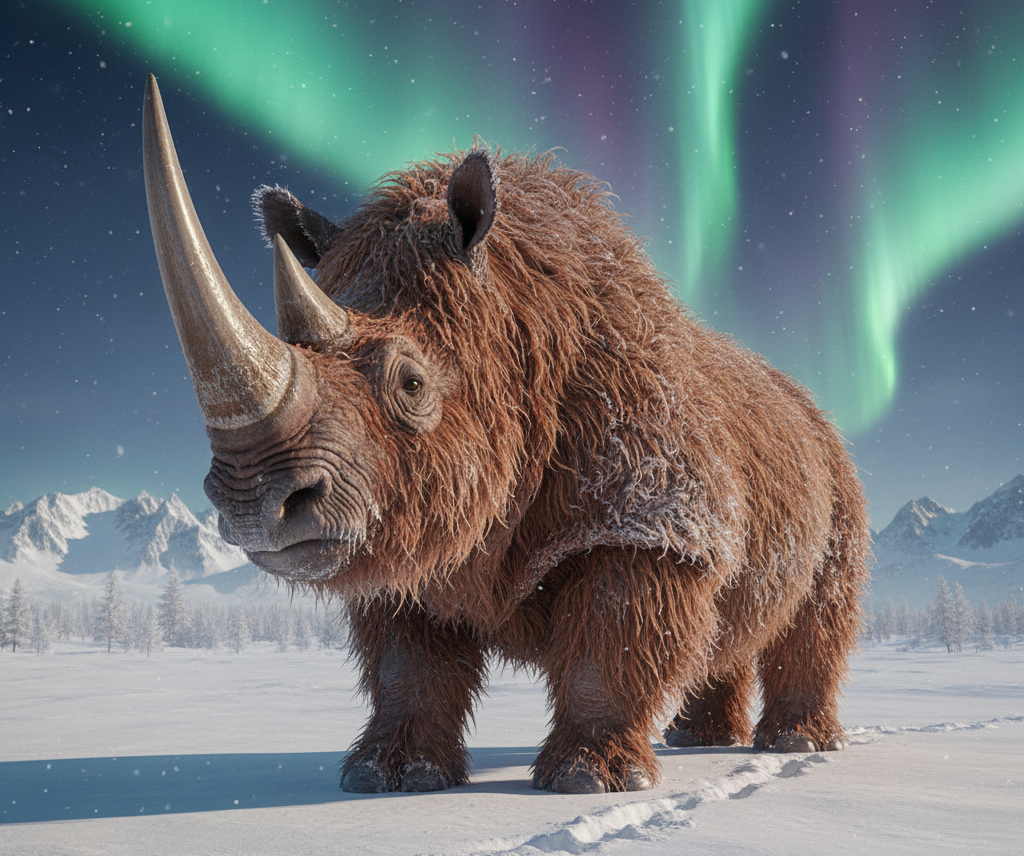
The Woolly Rhinoceros (Coelodonta antiquitatis)
One of the First Lives Erased by Humanity
The woolly rhinoceros was one of the most formidable herbivores of the Ice Age.
Perfectly adapted to subzero environments, it thrived on the frozen grasslands known as the mammoth steppe.
Thick skin, long shaggy hair, massive horns—
everything about this animal spoke of evolutionary success.
And yet, like the mammoth, it could not survive one encounter:
contact with Homo sapiens.
Basic Information
| Geographic range | Northern Eurasia (from Siberia to Western Europe) |
|---|---|
| Time range | ~350,000 to ~14,000 years ago |
| Height | ~1.8–2.0 meters |
| Diet | Herbivorous |
| Distinctive features | Long horns, cold-adapted body, dense fur |
The Path to Extinction
For tens of thousands of years, the woolly rhinoceros flourished in a relatively stable Ice Age ecosystem.
Climatic fluctuations alone cannot account for its sudden disappearance.
The timing of its decline closely matches the expansion of modern humans into northern Eurasia.
Its image appears repeatedly in Paleolithic cave art,
and archaeological remains reveal clear cut marks made by stone tools.
The evidence indicates that woolly rhinoceroses were hunted.
Why Humans Were Decisive
The woolly rhinoceros possessed powerful horns,
but these were effective only against solitary predators.
Human hunting strategies were fundamentally different:
- coordinated group attacks,
- maintaining distance,
- repeated strikes with weapons.
Such tactics rendered individual defenses useless.
- slow reproductive rates,
- dependence on a specialized habitat.
Together, these traits left populations unable to recover from sustained human pressure.
What the Woolly Rhinoceros’ Extinction Reveals
The woolly rhinoceros was not weak.
It was highly specialized, resilient, and successful in extreme conditions.
What it could not withstand was a predator unlike any before—
one capable of planning, cooperation, and technological innovation.
Like the mammoth, its extinction demonstrates that humans were no longer merely part of the environment.
They had become a force capable of reshaping it.
The Quiet Disappearance of a Giant
The extinction of the woolly rhinoceros was not dramatic.
It was gradual, regional, and irreversible.
Climate change alone cannot explain it.
Nor was it the result of malice.
It was the consequence of humanity’s earliest ecological footprint—
a mark that would never fade.
Extinction-related book